Showing posts with label Bill C-391. Show all posts

Tuesday, 11 January 2011

Gun Control is Also a Women's Issue


The interesting thing about staring down a gun barrel is how small the hole is where the bullet comes out, yet what a big difference it would make in your social schedule.

~P.J. O’Rourke, Holidays from Hell, 1989

This post was originally published on another of my
blogs on Oct. 9, 2009. I rerun it here in recognition of the tragic shootings in Arizona, where Rep. Gabrielle Giffords lies in intensive care, in a medically induced coma. The alleged shooter sounds Jared Loughren sounds, not to put too fine a point on it, like a nutbar. He wasn't acceptable to military recruiters, he was exiled from the classroom for his erratic speech and behaviour. But hey buddy, wanna buy a semiautomatic Glock with an extended magazine? No problem!

Who can't help but conclude that the ease of procuring guns--in the USA in general and Arizona in particular--is partly responsible for this incident, leaving 6 dead so far and 14 injured? There are some
300 million guns in the USA, a third of them handguns. One hundred million guns are in private hands, the highest level of gun ownership in the world. Is it any wonder it is also accompanied by the highest rate of firearm homicide of any industrialized country? Those who believe MORE guns would make the country safer are, you should pardon the expression, off their rockers.

Do you really think another person whipping a gun out in the midst of the Loughner melee would have resulted in FEWER casualties? Only in a Vin Diesel movie...


------------------------

Some 80 per cent of Canada's guns--numbering between 9 and 11 million, by various estimates--are owned by men, so perhaps by definition, gun control can be seen as a "woman's issue." And repeated polling shows a substantial majority of women support the gun registry, perhaps because we know that guns are often used to harm or intimidate women in the throes of domestic violence. Women around the world are at greatest risk of harm from their intimate partners—“the usual suspects” in such cases.

Fully 85 per cent of Canadian women who are murdered are killed by their spouse or partner, and most of those shot dead are killed with legally owned firearms.
Despite pro-gun lobby bluster, this gun violence is not just an urban phenomenon — the rate of women killed with guns is higher in rural areas because rural people own more guns. And murder is just the tip of the domestic violence iceberg—for every woman killed, many more are injured or threatened. And these “domestic violence” incidents appear in the papers almost daily. Several recent examples:

Smith AB, July 30th: Ian Jeffrey Paget kills estranged wife Joan Hanson, her daughter and granddaughter, and then turns the rifle on himself at her rural home in northern Alberta.


Kitchener ON, August 11th: Nadia Gehl is shot in early February at a bus stop close to her home. Waterloo police finally apprehend three suspects: her husband and two of his friends.


Orangeville ON, September 13th: Police investigate a murder-suicide that left a mother of two and her estranged husband dead. Witnesses say 39-year-old Heidi Ferguson, shot in the chest, sought help at a neighbour's. As she lay dying, Ferguson reportedly cried, "I've been shot by my husband ... please help me." An avid hunter and gun collector, Hugh Ferguson turned the gun on himself after a standoff with police.


Winnipeg MB, September 17th: Police are called after a 19-year-old woman is allegedly assaulted and threatened with a firearm. The woman flees the house and calls police from another area residence.


Fort St. John BC, September 30th: A northeastern B.C. man is shot and killed by the RCMP after a five-day standoff that began when the 41-year-old farm resident pursued a van carrying his wife, an unspecified number of children and a friend, and shot out the front tires.


Since the gun registry was created, close to 23,000 firearms licenses have been refused or revoked because of safety concerns. We register our cars and our dogs--not to register our guns would be criminal. No matter what the gun lobby says, gun control works. Consider the following :

· Controls on rifles and shotguns were strengthened in 1991: that year 1441 Canadians were killed with guns. By 2005, such deaths dropped by almost half, to 818.


· The number of Canadian women murdered with guns fell from 85 in 1991 to 32 in 2005. But the number of women murdered by weapons other than firearms declined only slightly during the same period of time. Again, the effectiveness of gun control is inescapable.

My son was at Dawson College on September 13, 2006 when Kimveer Gill went on his murderous rampage. I will never understand why Mr. Gill had such easy access to such enormous firepower--the fact that he managed to kill “only” a single young woman was due to the fortuitous coincidental presence of two brave and well-trained police officers. (I say “only” because, of course, for her parents, family and friends, the murder of 18-year-old Anastasia De Sousa is no small loss.) Kimveer Gill didn't need those guns and he shouldn't have had them. Why should his right to feel "big and bad" have trumped Ms. De Sousa’s, my son's, or anyone else’s safety? And so I support more gun control, not less. Please don’t let our Parliament send Bill C-391, the bill to dismantle the long-gun registry, to committee, the next step in the legislative process.

Though our Prime Minister may refuse to face it, rifles and shotguns are the firearms used most often to threaten women and children, and the weapons of choice in the murder of police officers. Look, for example, at the 4 Mounties killed in Mayerthorpe, AB. And the only charges levied in that case were against the gun providers, who were traceable only because of the gun registry! When Mr. Harper talks about law and order one day, and laxer gun control the next, I'm not sure whether to laugh or cry. Contact your MP on this issue. Don't let Mr. Harper play fast and loose with our children's lives.

Sunday, 19 September 2010

Support the gun registry or you don’t know jack


These are just a few recent stories in the country-soon-to-be-naked-of-the-long-gun-registry:

July 2009: Joan Hanson, daughter, and granddaughter shot dead by Ms. Hanson’s estranged hunter husband with his legally owned rifle, which he later turns on himself. January 2010: Stephanie Hoddinott shot dead by a former boyfriend, using a legally acquired handgun he then uses to kill himself. March 2010: three women shot near Belleville by a male acquaintance of one of them; two die. Within days, Const. Vu Pham is shot and killed by hunter Fred Preston, apparently despondent about the break up of his marriage. Weeks later, disgruntled Edmonton car dealership employee Dave Burns walks into work firing a sawed-off shotgun. Manager Garth Radons dies and Burns turns the gun on himself; he’d apparently been suspended for uttering racial slurs and posting sexually explicit photos mocking another employee. Radons’ wife, a police officer, is among the first on the scene.

How does the long gun registry help prevent this litany of death, including suicide, and crime, including murder? Knowing who has which guns allows police to remove them as a preventative measure, should it become necessary. In thePreston case, if his estranged wife had reported any threats he made to police, they could have removed Mr. Preston’s guns. ALL his guns, which isn’t possible if they aren’t all listed somewhere handy, like, say, a long gun registry.

Since its creation, some 22,000 firearms licences have been denied and over 8,000 guns surrendered and confiscated because of safety concerns like those posed by Mr. Preston. Of the revoked guns, 74 per cent were nonrestricted shotguns and rifles. The boundary between “law-abiding duck hunter” and “criminal” only takes a fraction of a second to breach: how long does it take to pull a trigger? In light of these statistics, how can opponents of the registry continue to deny it saves lives?

In fact, many lives have been lost at the hands of "legal" gun owners. Having a gun in the home, rather than making you safer, dramatically increases the chance of death. Those suspicious of statistics and their collection may prefer to believe in unreported crime and--coming soon to a parliament near you, perhaps--imaginary crime. (With the crime rate plummeting, we’ll need to fill all those new penitentiaries somehow.)

Dr. Ted Miller's 1995 look at gunshot wounds in Canada, published in the Canadian Medical Association Journal, estimated that 1991 gunshot wounds cost Canada $6.6 billion (1993 dollars), representing nearly $9 billion today. About $63 million was associated with medical and mental health and $10 million with public services; productivity losses exceeded $1.5 billion. The remaining dollars were attributed to "pain, suffering and lost quality of life." Miller didn’t take into account costs associated with the justice and incarceration systems, but it’s clear that the enormous costs of gun violence—including “legal gun” violence--dwarf the cost of the registry. Even preventing the loss of one or two lives—or one or two shootings--pays for the registry, if you’re callous enough to consider only dollars and cents. At $3-4 million a year, the long gun registry is an incredible bargain.

Jack Layton is supposedly a supporter of women’s rights and equality. He is also, supposedly, a supporter of the long gun registry. Well, the gun registry is a women’s issue, too: the vast majority of those long gun owning “duck hunters” are men. The vast majority of individuals threatened, shot and killed in domestic disputes are women.

The RCMP and the associations of chiefs of police, the women’s organizations, suicide prevention, emergency and other medical associations have unequivocally come out in favour of the gun registry, proven a critical tool in the prevention of suicide and domestic violence, especially in rural settings.

Gutting the registry when all these groups are in favour of it and the “duck hunters” are against it is really letting the tail wag the dog. If this same “duck hunter” brain trust decided that our murder laws don’t prevent murder, would you strike those laws down, too, Mr. Harper?

So there you have it, Messrs. Harper and Layton: either you ensure the registry survives, or you betray your sacred responsibility to Canadians, including women and rural people. Either you support the registry or you don’t know jack.

(Appeared in The Hill Times, Sept. 13, 2010; p.17)

Saturday, 29 May 2010

When a picture is worth a thousand words


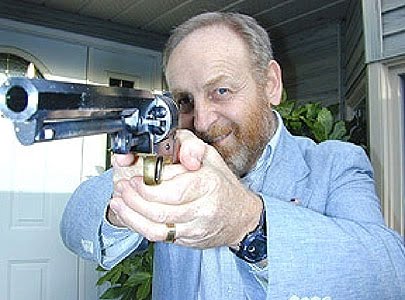
The meaning of the phrase “a picture's worth a thousand words” was made manifest at this week’s hearings on Bill C-391, the Conservatives’ latest attempt to murder the long-gun registry, a registry the Supreme Court of Canada has ruled to be an essential component of our gun safety system. Tune into the House of Commons hearings of the Standing Committee on Public Safety and National Security (SECU) at

http://parlvu.parl.gc.ca/ParlVu/ContentEntityDetailView.aspx?ContentEntityId=6217; around 1hr 51 minutes into the session, Bloc Quebecois MP and SECU member Maria Mourani brandishes the attached image of Gary Mauser, appearing as a private individual, though he was in fact appointed in 2007 to the government’s firearms advisory committee (FAC). Mourani shows Mauser the photo, verifies it is of him, and asks how many guns he owns.

“I’m not sure,” Mauser responds.


She presses a bit more—“How many shotguns do you have?...You have guns but you don’t remember how many?”


Mauser finally responds lamely, “I’m getting old.”


“By contrast, you aren’t too old to carry a weapon like this, though,” she counters.


“…the photographer asked me to pose like this and I resisted. And obviously, I should have resisted harder,” he admits.


“So you’re the big advisor on issues that concern firearms,” Mourani finishes. The photo shows Mauser aiming but Mourani’s the one who scored the direct hit.


The photo illustrated Susan Delacourt’s 2007 Toronto Star article “Panel loaded with gun buffs,” about the then-new makeup of the Conservative’s FAC. Originally from the Canadian National Firearms Association website, the image was, for obvious reasons, quickly removed. But it haunts us still, as does Mauser’s committee, which was, Delacourt wrote, “appointed and operating in virtual secrecy…made up almost entirely of pro-gun advocates opposed to the firearms registry.”


Mauser is touted as an emeritus professor and éminence grise of Canada's gun lobby. In 2006, when the Conservative government cleansed the FAC of police organization representatives, suicide prevention experts, women's and health advocates, they then appointed gun dealers and people like Mauser and Tony Bernardo, head of the Canadian branch of the US National Rifle Association (NRA). In 2001, Bernardo crowed to his Canadian Institute for Legislative Action (CILA), “We have been working hand in hand with the NRA regarding international issues for the past three and a half years...in fact, the NRA was instrumental in the formation of CILA…the NRA provides CILA with tremendous amounts of logistic support.”


By an amazing coincidence, the NRA's lobby arm is called the Institute for Legislative Action.


Okay, maybe it isn’t a coincidence.


Bernardo also appeared before SECU last week. Interestingly, CILA’s website doesn’t appear to have been updated since 2008, but the website of an allied group, the Canadian Shooting Sports Association (CSSA) carries an endorsement by Wayne LaPierre, NRA Executive VP: “The NRA of America supports and endorses the work done by the CILA and strongly encourages all Canadian firearms owners to become CILA supporting members.” Another recent posting has LaPierre saying repeal of Canada’s long-gun registry would be “huge on the world stage and made all the more significant as a backdrop in the pending debate on the United Nations' global gun ban…As my friend and colleague Dave Kopel, research director of the Independence Institute in Colorado, astutely noted, ‘Repeal of the Canadian registry would be of tremendous global significance. Repeal would also shatter the claim by the Canadian gun prohibition lobby that gun control in Canada is an irreversible ratchet.’”


These two themes—the derailing of the UN’s international treaty limiting trade in small arms (responsible for about a thousand deaths daily), and that gun control anywhere threatens the right to bear arms everywhere--are traditional NRA bugaboos, as discussed in the New York Times by Josh Kurlantzick, special correspondent for The New Republic and a visiting scholar at the Carnegie Endowment for International Peace (see “Global Gun Rights?”, NYT, September 17, 2006).


Ostensibly, the NRA constitution prevents it from giving money to groups outside the USA but according to Kurlantzick, the NRA stopped openly fighting gun control abroad because it “enabled gun-control advocates to accuse local gun lobbies of selling out to America.”

Instead, the NRA counsels indigenous gun lobbies to recast restrictions on gun ownership as threats to civil liberties. Indeed, Al Dorans, CILA’s 2001 operations director is on record noting that CILA and the NRA “shared a belief in the existence of a worldwide conspiracy to rid the world civilian population of small arms such as hunting and sport rifles, shotguns and handguns,” according to a 2001 article by Tim Naumetz for Southam Newspapers. The NRA has also repeatedly given “lobbying seminars” during Canadian election campaigns.


Though Bill C-391 masquerades as a private member's bill, when ministers of the Crown speak on behalf of a bill and spend money on fliers attacking opposition members for their stance on a bill, well, if it waddles like a duck and quacks like a duck, chances are it's a friggin’ duck. And, as NRA style paranoia spreads, it is clear that the organization is up to its eyeballs in Canada’s gun lobby, and has been for some time.

Friday, 21 May 2010

Canada's long-gun registry cost-effective life saver

"If you think education is expensive, try ignorance," said Derek Bok, president of Harvard University president for over 20 years.

A similar analogy applies to the long-gun registry, as activists and objective observers alike are making clear.

In 1995, Ted Miller turned his attention to the costs associated with gun violence in Canada. Miller is an internationally recognized safety economist and leading expert on injury incidence, costs and consequences, with more than 150 studies and more than 200 scholarly publications under his belt.

The cost estimates he produces are used by the U.S. Department of Transportation, the U.S. Consumer Product Safety Commission, the Justice Department and several foreign governments.

Miller's look at gunshot wounds in Canada, published in the Canadian Medical Association Journal, estimated that gunshot wounds in 1991 cost Canada $6.6 billion (in 1993 dollars). That represents about $8.95 billion in today's money.

Miller found about $63 million was associated with medical and mental health costs, $10 million on public services, and that productivity losses exceeded $1.5 billion; the remaining dollar value was attributed to "pain, suffering and lost quality of life."

Clearly, even the dollar costs of gun violence are considerable. Not to mention the non-monetary costs of "pain, suffering and lost quality of life."

Fast-forward to 2003. The CMAJ issues an editorial in support of gun registration in Canada, saying dismantling the long gun registry would be, "a serious mistake ... (because) registration is a key part of the strategy to reduce mortality and morbidity resulting from the misuse of privately owned guns and the legal trade in firearms."

The editorial emphasizes 80 per cent of firearm deaths are due to suicides, 15 per cent to homicides and four per cent are accidental.

So injuries and deaths of just over 200 people per year account for costs of nearly $9 billion.

You don't have to be a Harvard president to understand that gun violence is a significant Canadian social problem. And that successful efforts to curtail it should be lauded, not destroyed.

Whatever overruns may have been associated with the registry's setup, it now annually costs only $3 million to $4 million. If it prevents even one or two gunshot injuries, it may well have already paid for itself.

A new website, truthsandmyths.ca, describes the registry's successes and counters gun lobby lies.

Today, as in the days of Miller's analysis, "The vast majority of firearm deaths in Canada are not gang-related, but occur when an ordinary citizen becomes suicidal or violent, often under the influence of alcohol or drugs, or during a personal crisis such as marital breakdown or job loss. When firearms are available, domestic homicides are more likely to involve multiple victims and end in suicide," says a recent statement from 28 Canadian health organizations and 33 individuals.

The statement "Firearms Control and Injury Prevention: The gun registry is a good investment" also describes the results since the registry's advent: "an astonishing decrease of 43 per cent of all gun deaths since 1991," with the greatest progress being in deaths associated with rifles and shotguns. Most suicides among those 15-35 years old involve firearms "easily accessible in the home"; such deaths decreased 64 per cent between 1995 and 2005, "with no evidence of substitution with other methods."

There is little doubt that Canada's gun lobby is supported and advised by the U.S. National Rifle Association (NRA). Wayne LaPierre, NRA executive vice-president, wrote recently on the Canadian Sports Shooting Association website, "if all goes well in the Canadian Parliament, Dominion gun owners will be freed from 14 years of living under the crushing weight of a bureaucratic, scandal-ridden, wasteful, invasive, $2 billion, error-ridden and inarguably worthless long-gun registry."

He described the November vote against the registry as "a stunning victory for gun owners" and quotes the research director of the ultra-conservative Colorado-based Independence Institute as saying the registry's repeal "would be of tremendous global significance."

But a majority of Canadians actually believe in the registry: a new poll shows more than twice as many of us want to keep it as wish to scrap it (59 per cent versus 27 per cent), that women support the gun registry more than men (66 per cent versus 51 per cent), that more people living with gun owners support the registry than oppose it (47 per cent versus 36 per cent) and that a substantial proportion of gun owners themselves (36 per cent) support it.

The gun lobby may be louder and better financed, but even among households with guns in Canada, votes are almost evenly split.

While the gun lobby blusters that the licensing provisions of the Firearms Act provide adequate safeguards, the truth is that licensing only functions with registration as its backup. Our Supreme Court even issued a ruling to this effect.

The registry provides police with the number and type of firearms each licensed individual owns. If a gun owner is deemed dangerous to himself (or others), in the absence of the registry, how can a prohibition order be enforced?

Safe storage rules are similarly unenforceable if there's no proof of ownership for a gun in question.

Dismantling the long-gun registry would be a huge blow to the Firearms Act as a whole, undermining public safety.

So if you think gun control is expensive, try gun deaths.

(Published Tuesday May 18th, 2010 in The Daily Gleaner)