Sunday, 19 September 2010

Support the gun registry or you don’t know jack


These are just a few recent stories in the country-soon-to-be-naked-of-the-long-gun-registry:

July 2009: Joan Hanson, daughter, and granddaughter shot dead by Ms. Hanson’s estranged hunter husband with his legally owned rifle, which he later turns on himself. January 2010: Stephanie Hoddinott shot dead by a former boyfriend, using a legally acquired handgun he then uses to kill himself. March 2010: three women shot near Belleville by a male acquaintance of one of them; two die. Within days, Const. Vu Pham is shot and killed by hunter Fred Preston, apparently despondent about the break up of his marriage. Weeks later, disgruntled Edmonton car dealership employee Dave Burns walks into work firing a sawed-off shotgun. Manager Garth Radons dies and Burns turns the gun on himself; he’d apparently been suspended for uttering racial slurs and posting sexually explicit photos mocking another employee. Radons’ wife, a police officer, is among the first on the scene.

How does the long gun registry help prevent this litany of death, including suicide, and crime, including murder? Knowing who has which guns allows police to remove them as a preventative measure, should it become necessary. In thePreston case, if his estranged wife had reported any threats he made to police, they could have removed Mr. Preston’s guns. ALL his guns, which isn’t possible if they aren’t all listed somewhere handy, like, say, a long gun registry.

Since its creation, some 22,000 firearms licences have been denied and over 8,000 guns surrendered and confiscated because of safety concerns like those posed by Mr. Preston. Of the revoked guns, 74 per cent were nonrestricted shotguns and rifles. The boundary between “law-abiding duck hunter” and “criminal” only takes a fraction of a second to breach: how long does it take to pull a trigger? In light of these statistics, how can opponents of the registry continue to deny it saves lives?

In fact, many lives have been lost at the hands of "legal" gun owners. Having a gun in the home, rather than making you safer, dramatically increases the chance of death. Those suspicious of statistics and their collection may prefer to believe in unreported crime and--coming soon to a parliament near you, perhaps--imaginary crime. (With the crime rate plummeting, we’ll need to fill all those new penitentiaries somehow.)

Dr. Ted Miller's 1995 look at gunshot wounds in Canada, published in the Canadian Medical Association Journal, estimated that 1991 gunshot wounds cost Canada $6.6 billion (1993 dollars), representing nearly $9 billion today. About $63 million was associated with medical and mental health and $10 million with public services; productivity losses exceeded $1.5 billion. The remaining dollars were attributed to "pain, suffering and lost quality of life." Miller didn’t take into account costs associated with the justice and incarceration systems, but it’s clear that the enormous costs of gun violence—including “legal gun” violence--dwarf the cost of the registry. Even preventing the loss of one or two lives—or one or two shootings--pays for the registry, if you’re callous enough to consider only dollars and cents. At $3-4 million a year, the long gun registry is an incredible bargain.

Jack Layton is supposedly a supporter of women’s rights and equality. He is also, supposedly, a supporter of the long gun registry. Well, the gun registry is a women’s issue, too: the vast majority of those long gun owning “duck hunters” are men. The vast majority of individuals threatened, shot and killed in domestic disputes are women.

The RCMP and the associations of chiefs of police, the women’s organizations, suicide prevention, emergency and other medical associations have unequivocally come out in favour of the gun registry, proven a critical tool in the prevention of suicide and domestic violence, especially in rural settings.

Gutting the registry when all these groups are in favour of it and the “duck hunters” are against it is really letting the tail wag the dog. If this same “duck hunter” brain trust decided that our murder laws don’t prevent murder, would you strike those laws down, too, Mr. Harper?

So there you have it, Messrs. Harper and Layton: either you ensure the registry survives, or you betray your sacred responsibility to Canadians, including women and rural people. Either you support the registry or you don’t know jack.

(Appeared in The Hill Times, Sept. 13, 2010; p.17)

Monday, 13 September 2010

The solution is simple: Canada needs MORE gun controls


The late Anastasia De Sousa, who died at Dawson College, September 13, 2006

Today being the fourth anniversary of the tragic murder of another "beautiful young Canadian with everything to live for," Anastasia De Sousa, during the Dawson College Shooting , I've decided to post the opinion article I wrote following the Sept. 13, 2006 rampage by the deranged Kimveer Gill. Versions of this piece appeared at the time in The Montreal Gazette and The National Post. The memorial notice for Ms. De Sousa is here; you may leave a message of condolence here.

-----------------

I am the mother of a Dawson College student, was friendly with a beloved husband and father killed at Concordia University 14 years ago, and worked in a non-traditional occupation - molecular genetics research - when the Ecole Polytechnique massacre took place. My husband is a provincial politician who spends much of the year at the National Assembly in Quebec City, where three were killed and 13 wounded by a deranged Canadian soldier in 1984. And so I feel myself uniquely placed to respond to the events of Sept. 13.

My response is not to launch a fruitless inquiry into the "root causes" of this catastrophic occurrence. I couldn't care a whit whether the perpetrator of last Wednesday's atrocities was refused academic admission to Dawson College, whether he was bullied as a child, either in school or at home. I think it's irrelevant if he grew up with a chip on his shoulder because of some imagined slight, or even if he or his family suffered in the past from some form of persecution, be it real or imagined, in Canada or elsewhere.

To me, there can be no mitigating factors for murder, whether the locus of attack is a college campus in downtown Montreal, a nightclub in Tel Aviv, a skyscraper in New York City, or some parched crossroads among the rubble of Afghanistan. Murder is murder is murder. Each one should fall under the rubric of "hate crime."

When 14 young Montrealers, full of hope, ambition and promise, had their lives snuffed out because they had earned the privilege of studying engineering while another could not, many people I knew, especially women, insisted the "root cause" of this crime was our society's oppression of women, an opinion at which I scoffed.

When gun control was trumpeted as the panacea to these horrible killings, I was skeptical. I bought the argument that gun control penalized the law-abiding, rather than the criminals. I was sensitive to the position that people living rural lifestyles needed firearms as part of their daily lives, a situation unimaginable to me, given my urban existence.

Well, I am skeptical and sensitive no more. Last Wednesday was the drop that made the glass overflow, as we say in Quebec. The balance has shifted. I realize more clearly now that my choice must be to care more for the potential victims than the potential perpetrators.

So that's my response to the Dawson killings: No more guns. It's as simple as that. Because no one can accurately predict who among us will become unhinged enough to explode in bloody slaughter, I believe that guns should be unavailable to the public.

I don't trust psychiatrists - much less gun-registry officials - to ferret out what lies deep in the hearts of men. After all, Concordia administrators, some of whom had equipped their own offices with locks and panic buttons because of Valery Fabrikant's continued harassment, consulted a psychiatrist about the demented professor before his murderous rampage. I saw the same psychiatrist on television last week, hovering in the background following the Dawson shootings.

According to journalist Morris Wolfe, the psychiatrist had deemed it "unlikely" that Fabrikant, a professor repeatedly denied tenure, would become violent.

So if a trained psychiatrist with an abiding interest in severe and chronic psychotic illness, confronted with a man he himself has diagnosed as having "a personality disorder" cannot foresee the coming explosion of rage, all the administrative screening in the world won't be able to keep legal guns out of the hands of loonies. The solution that's clearest to me is to make guns - both legal and illegal - impossible to get.

And so, as a mother, a woman, and a sentient human being, I'm telling Prime Minister Stephen Harper and the entire government of Canada to wake up and smell the coffee: If you persist in your intended dismantling of the gun registry instead of making it harder for people to own guns, there will be hundreds of thousands of us marching in the streets of Montreal. I guarantee it.

----------

I continue to believe that guns, especially long guns, are too readily available in our society. The government of Canada--under the guise of a private member's bill--is attempting to destroy the long gun registry, part of a web of regulations that seeks to make Canada's gun owners more accountable for their weapons and has been shown effective and even cost-effective.

The psychiatrist, Warren Steiner, contacted me after my piece(s) appeared to say Mr. Wolfe had it all wrong and that he--Dr. Steiner--regretted not having demanded retraction of the statements ascribed to him. Four years later, the comments are still available here. Dr. Steiner has since made the recovery--or lack thereof--of the Dawson community a particular research interest. And it looks to be a lucrative, longterm one.

Thursday, 26 August 2010

The Maytag Repairman: Lonely No More!


It’s been a terrible month for appliances chez moi. First, and disaster de tutti disasters, my laptop of nearly 4 years’ vintage crashed. Literally, taking a swan dive off our kitchen table and landing, screen first, on the floor. It seemed none the worse for wear at the time, but next morning, on rebootation, I received a message so traumatic, I seem to have blanked it out (either that, or the Alzheimer’s is proceeding faster than I thought). Worse than the blue screen of death, it said, “No recognized operating system.”

Cue stab scene music from Psycho.

And the best part—okay, the worst part--is that the crash happened in early August and my last external backup was—cue sad chamber music by string quartet on the deck of the Titanic—June 21st. So let that be a lesson to you: back up your hard drives, people.

But I digress: today’s subject is Maytag repairmen, and the complete opposite of their loneliness, and my laptop wasn’t made by Maytag. My dishwasher, however, is another story.

Last summer, we finally decided to renovate our 1950s kitchen. It wasn’t quite the reno of our dreams--that would have cost at least another $5,000. Let’s call it the-reno-of-our-dimished-but-wholly-practical expectations. But there was the dishwasher dilemma: ours still worked, but it was 10 years old. Should we keep it till it died, or spring for a new one?

We opted for door number 2. Cue buzzer for wrong answer from Family Feud. Worse, instead of our usual bottom of the line, department store brand, we sprang for a Maytag.

Why?

I have no answer except the salesman’s recommendation, the middle of the road price and—let’s face it, they’d hardly spend the billions if it didn’t work—the advertising. Did we want the extended warranty?

No, we did not.

Foolish us.

But in nearly 30 years of marriage, we’d had 3 dishwashers and maybe 2 repair calls. Extended warranty? What for? It was a Maytag. Extended warranties were how they gouged you; everyone knew that!

Did I mention we were foolish?


Dishwasher purchased June 2009; expiration of manufacturer’s warranty: June 2010; dishwasher death: August 2010.

I called the toll-free repair service. Did you know that Whirlpool bought Maytag and now comprises some 8 or 9 brands? Together they represent the OPEC of household appliances.

A tech came and consulted the entrails of a chicken: we needed a replacement electrical panel. Replacement electrical panel: $100. Two service calls: $150. The feeling you get spending $250 to fix a year-old dishwasher bought for $750 (and still being paid for): priceless.


I was ticked. Seriously. Told the pudgy young service dude, “Tell your supervisor how seriously ticked I am that our dishwasher is broken a mere 14 months after purchase.”

His answer: “I never see a supervisor. They’re in Ontario.” To a true Quebecois, Ontario is like, oh, I don’t know, the frigging moon or something. And vice versa, I’m sure.

Four business days to get the part, he said.

Of course, I had to wait much longer than four days, and finally called to inquire where said part was, only to be told the repair wasn’t in their system.

This frightened me: they had a system? For manufacturing substandard appliances and failing to repair them in a timely manner?

Who, exactly, was in charge of this “system,” the ex-cons from Enron?

I told Katie, the customer service rep with the nice Southern drawl—and I’m not talkin’ south’n Ontario, neithah—how upset I was to be paying $250 to fix a dishwasher purchased for $750 not quite a year ago. She put me on hold. I waited.

They would cover the part, she finally told me; the service charges, however, were all mine.

I subsequently googled Maytag dishwasher repair: in June 2010, some 1.7 million dishwashers—same manufacturer, but branded Maytag, Jenn-Air, Amana, Admiral, Crosley, Magic Chef, and Performa—had been recalled. Produced between 2006 and 2010, the dishwashers risked “an electrical failure in the dishwasher's heating element” posing “a serious fire hazard.” As opposed to an unserious fire hazard.

Twelve reports of fires, one “of extensive kitchen damage” but luckily, “no injuries.” So far.
Of course, my dishwasher didn’t fall into that recall, but I have high hopes for the next one.

At least, with 1.7 million dishwashers recalled for servicing, you can be certain of one thing: that ol' Maytag repairman sure ain’t lonely no more!

Wednesday, 23 June 2010

The Boys of Summer


Maybe we are, as Hanna Rosin argues in the current Atlantic, facing “The End of Men,” but I’d like to announce that men are alive and well and gazing into their creative navels here in Montreal. See the Summer Literary Seminars which kicked off earlier in the week at Concordia University.

At a cool two grand for tuition alone, the event is a little steep for my blood, but I relish the opportunity to attend the free sessions this combination workshop/conference/bacchanal, brainchild of the redoubtably energetic Mikhail Iossel, has on offer. It’s the equivalent of mini literary festival, just what this city needs as it girds its loins for the upcoming music and laugh-fests. After over a decade of SLS St. Petersburg, Russia, Iossel, now professor of creative writing at Concordia, has expanded to Montreal.

Monday morning, I heard Joel Yanofsky speak about Mordecai Richler and Sherry Simon on language and translation. Fascinating stuff, if a little short on detail. (Despite repeated requests by a Torontonian that she clarify how many Montreal Anglos and Allos there actually are, Simon refused to answer. “It depends on who you ask,” she kept saying. “It’s all so political.” Spoken like a true academic.) Then post-modern fabulist Robert Coover delivered a pretty dreary lecture on a Brown University project he participates in called CAVE: Computer Audio Visual Environment. Basically, a 3D immersion in sound, image and text. Which had me thinking that if this is the future, writing is already dead.

Thursday, Joel Yanofsky offered a second lecture, “Confessions of a Literary Stalker.” Mostly about Mordecai and Joel Yanofsky and Yann Martel and Joel Yanofsky—okay, let’s face it, Joel Yanofsky basically writes about people who have talked with Joel Yanofsky (I guess that’s why it’s called personal writing)! And, to be sure, he is clever and self-deprecatingly amusing enough to carry it off. Describing the process that led to his becoming obsessed with Richler, Yanofsky started off with his foray into teaching grade 7 and 8 students 30 hours-worth of personal writing. He asked them to write about something they were expert at, but quickly discovered the kids preferred their peers’ stories about things they had flubbed, as opposed to aced. (Remember, “if it’s happy, it’s not literature.”) Which sat very well with a belief of Yanofsky’s crystallized in an interview with Brian Moore some years back. Moore had been inspired by some other writer’s first novel, a novel “so bad, it inspired him to write his own.” The bad novel, which Moore would never name, turned out, according to William Weintraub, to be Mordecai Richler’s “The Acrobats.”

Proof that “We do what we do for all the wrong reasons,” according to Yanofsky, meaning writers are partly (wholly?) motivated by envy and the art of one-up-manship. Yanofsky went on to discuss what writers desire most deeply—“to make a splash. And we’ll settle for a little one if we can’t make a big one.” Writing as pissing contest (piss splashes, doesn’t it?). Or as male display behaviour. My terms, of course.

During the course of the Yanofsky entertainment—and, there’s no denying, fun to listen to he is—his discourse was peppered with allusions to a number of other illustrious writers: Orwell, David Gilmour, Martin Amis (who apparently expressed some concern about Yanofsky’s mental health), Kingsley Amis, E.M. Forster, Henry James, Ingmar Bergman, Nicholson Baker, John Updike, Saul Bellow, Mark Harris, Philip Roth, Paul Theroux (followed immediately by V.S. Naipaul, needless to say), J.D. Salinger, Jeff Dyer, D.H. Lawrence, Guy Vanderhaeghe, James Joyce, (noticing a pattern yet, by any chance? Anyone? Anyone??), and finally, Yann Martel. Since Yanofsky’s writing is a hybrid of stand-up and confessional, we were treated to the tale of his totally cringe-worthy episode on the eve of the awarding of the Booker for “Life of Pi,” a novel, Yanofsky admitted, he hadn’t bothered to finish and apparently was invited to dis live on television immediately following the Booker announcement—“I could either be bitter and envious or a suck-up,” Yanofsky said. “Those were my choices.”

I love listening to Yanofsky—I’ve read all of his books, two-thirds of them years before I’d met him. But I can't tell you how disappointed I was to discover he apparently doesn’t seem to consider a single woman writer from Canada worth mentioning.

Okay, maybe I can.

To bend over backward in the fairness department, Carole Shields’ name did surface, but only in the context of the Booker shortlist.

Next up were Jon Paul Fiorentino and David McGimpsey, discussing contemporary Montreal literature, and moderated by Alessandro Porco (who graduated from Concordia’s writing program and now teaches in Buffalo). Some time was spent examining the definition of “Montreal writer”: those born and raised here who have stayed or left, those who moved here and stayed, those who moved here and left (e.g. post-degree), those who took a wrong turn on the 401 and wrote a suicide note, etc. Turns out that, by the panel’s standards, just about anyone who dallied in Montreal for more than five minutes (long enough to ingest a poutine or take a flyer on a BIXI) is entitled to moniker himself “a Montreal writer.” Though why someone who spent a couple of years in a degree program and then high-tailed it ASAP would want to be considered a Montreal writer is anyone’s guess.

You will perhaps be pleased to learn Montreal writing is also now moving past the era of Leonard Cohen, and that reading Richler is no longer de rigueur (McGimpsey mentioned this as though it was a good thing). At least, during this segment, which sounded more like an ad for Concordia’s creative writing program than anything else, a couple of women’s names were actually—amazingly!—uttered: Heather O’Neill’s name twice, Zoe Whittall once.

At least McGimpsey was man enough to mention the mass exodus of Anglos in the years that followed the first election of the Parti Quebecois in 1976, and made reference to the political situation between French and English, which is, episodically, fractious.

Later in the day, an actual woman—Alana Cox—was due to “own the podium,” as we Canadians like to say. At least, she was to be part of a discussion on the state of Canadian publishing. But I had had enough. Between them, Yanofsky, Fiorentino and McGimpsey had clearly established that writing in Montreal is a boys club anon—if not an old boys club—and I decided I had better leave the auditorium and attend to an episode of the vapours.

Beverly Akerman is a Pushcart-nominated Montreal writer (born and always lived here variety). Nineteen of her stories are published or in press, one of them a finalist for the Hoffer Award/Best New Writing 2011. Her unpublished collection “The Meaning of Children” just won the David Adams Richards Prize.

The Summer Literary Seminar’s free panels and lectures continue through June 27.

For more on women and writing in Montreal and Canada, check out:
http://www.cbc.ca/consumer/story/2009/12/18/consumer-blogger-james-chartrand.html?ref=rss
http://maisonneuve.org/blog/2010/01/07/how-make-it-writer-be-man/

(a version of this post was originally published on The Rover, Montreal's Online Arts Magazine)

Saturday, 29 May 2010

When a picture is worth a thousand words


The meaning of the phrase “a picture's worth a thousand words” was made manifest at this week’s hearings on Bill C-391, the Conservatives’ latest attempt to murder the long-gun registry, a registry the Supreme Court of Canada has ruled to be an essential component of our gun safety system. Tune into the House of Commons hearings of the Standing Committee on Public Safety and National Security (SECU) at

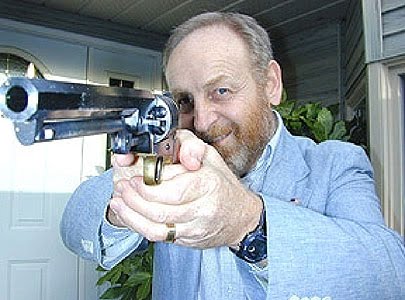
http://parlvu.parl.gc.ca/ParlVu/ContentEntityDetailView.aspx?ContentEntityId=6217; around 1hr 51 minutes into the session, Bloc Quebecois MP and SECU member Maria Mourani brandishes the attached image of Gary Mauser, appearing as a private individual, though he was in fact appointed in 2007 to the government’s firearms advisory committee (FAC). Mourani shows Mauser the photo, verifies it is of him, and asks how many guns he owns.

“I’m not sure,” Mauser responds.


She presses a bit more—“How many shotguns do you have?...You have guns but you don’t remember how many?”


Mauser finally responds lamely, “I’m getting old.”


“By contrast, you aren’t too old to carry a weapon like this, though,” she counters.


“…the photographer asked me to pose like this and I resisted. And obviously, I should have resisted harder,” he admits.


“So you’re the big advisor on issues that concern firearms,” Mourani finishes. The photo shows Mauser aiming but Mourani’s the one who scored the direct hit.


The photo illustrated Susan Delacourt’s 2007 Toronto Star article “Panel loaded with gun buffs,” about the then-new makeup of the Conservative’s FAC. Originally from the Canadian National Firearms Association website, the image was, for obvious reasons, quickly removed. But it haunts us still, as does Mauser’s committee, which was, Delacourt wrote, “appointed and operating in virtual secrecy…made up almost entirely of pro-gun advocates opposed to the firearms registry.”


Mauser is touted as an emeritus professor and Ă©minence grise of Canada's gun lobby. In 2006, when the Conservative government cleansed the FAC of police organization representatives, suicide prevention experts, women's and health advocates, they then appointed gun dealers and people like Mauser and Tony Bernardo, head of the Canadian branch of the US National Rifle Association (NRA). In 2001, Bernardo crowed to his Canadian Institute for Legislative Action (CILA), “We have been working hand in hand with the NRA regarding international issues for the past three and a half years...in fact, the NRA was instrumental in the formation of CILA…the NRA provides CILA with tremendous amounts of logistic support.”


By an amazing coincidence, the NRA's lobby arm is called the Institute for Legislative Action.


Okay, maybe it isn’t a coincidence.


Bernardo also appeared before SECU last week. Interestingly, CILA’s website doesn’t appear to have been updated since 2008, but the website of an allied group, the Canadian Shooting Sports Association (CSSA) carries an endorsement by Wayne LaPierre, NRA Executive VP: “The NRA of America supports and endorses the work done by the CILA and strongly encourages all Canadian firearms owners to become CILA supporting members.” Another recent posting has LaPierre saying repeal of Canada’s long-gun registry would be “huge on the world stage and made all the more significant as a backdrop in the pending debate on the United Nations' global gun ban…As my friend and colleague Dave Kopel, research director of the Independence Institute in Colorado, astutely noted, ‘Repeal of the Canadian registry would be of tremendous global significance. Repeal would also shatter the claim by the Canadian gun prohibition lobby that gun control in Canada is an irreversible ratchet.’”


These two themes—the derailing of the UN’s international treaty limiting trade in small arms (responsible for about a thousand deaths daily), and that gun control anywhere threatens the right to bear arms everywhere--are traditional NRA bugaboos, as discussed in the New York Times by Josh Kurlantzick, special correspondent for The New Republic and a visiting scholar at the Carnegie Endowment for International Peace (see “Global Gun Rights?”, NYT, September 17, 2006).


Ostensibly, the NRA constitution prevents it from giving money to groups outside the USA but according to Kurlantzick, the NRA stopped openly fighting gun control abroad because it “enabled gun-control advocates to accuse local gun lobbies of selling out to America.”

Instead, the NRA counsels indigenous gun lobbies to recast restrictions on gun ownership as threats to civil liberties. Indeed, Al Dorans, CILA’s 2001 operations director is on record noting that CILA and the NRA “shared a belief in the existence of a worldwide conspiracy to rid the world civilian population of small arms such as hunting and sport rifles, shotguns and handguns,” according to a 2001 article by Tim Naumetz for Southam Newspapers. The NRA has also repeatedly given “lobbying seminars” during Canadian election campaigns.


Though Bill C-391 masquerades as a private member's bill, when ministers of the Crown speak on behalf of a bill and spend money on fliers attacking opposition members for their stance on a bill, well, if it waddles like a duck and quacks like a duck, chances are it's a friggin’ duck. And, as NRA style paranoia spreads, it is clear that the organization is up to its eyeballs in Canada’s gun lobby, and has been for some time.

Friday, 21 May 2010

Canada's long-gun registry cost-effective life saver

"If you think education is expensive, try ignorance," said Derek Bok, president of Harvard University president for over 20 years.

A similar analogy applies to the long-gun registry, as activists and objective observers alike are making clear.

In 1995, Ted Miller turned his attention to the costs associated with gun violence in Canada. Miller is an internationally recognized safety economist and leading expert on injury incidence, costs and consequences, with more than 150 studies and more than 200 scholarly publications under his belt.

The cost estimates he produces are used by the U.S. Department of Transportation, the U.S. Consumer Product Safety Commission, the Justice Department and several foreign governments.

Miller's look at gunshot wounds in Canada, published in the Canadian Medical Association Journal, estimated that gunshot wounds in 1991 cost Canada $6.6 billion (in 1993 dollars). That represents about $8.95 billion in today's money.

Miller found about $63 million was associated with medical and mental health costs, $10 million on public services, and that productivity losses exceeded $1.5 billion; the remaining dollar value was attributed to "pain, suffering and lost quality of life."

Clearly, even the dollar costs of gun violence are considerable. Not to mention the non-monetary costs of "pain, suffering and lost quality of life."

Fast-forward to 2003. The CMAJ issues an editorial in support of gun registration in Canada, saying dismantling the long gun registry would be, "a serious mistake ... (because) registration is a key part of the strategy to reduce mortality and morbidity resulting from the misuse of privately owned guns and the legal trade in firearms."

The editorial emphasizes 80 per cent of firearm deaths are due to suicides, 15 per cent to homicides and four per cent are accidental.

So injuries and deaths of just over 200 people per year account for costs of nearly $9 billion.

You don't have to be a Harvard president to understand that gun violence is a significant Canadian social problem. And that successful efforts to curtail it should be lauded, not destroyed.

Whatever overruns may have been associated with the registry's setup, it now annually costs only $3 million to $4 million. If it prevents even one or two gunshot injuries, it may well have already paid for itself.

A new website, truthsandmyths.ca, describes the registry's successes and counters gun lobby lies.

Today, as in the days of Miller's analysis, "The vast majority of firearm deaths in Canada are not gang-related, but occur when an ordinary citizen becomes suicidal or violent, often under the influence of alcohol or drugs, or during a personal crisis such as marital breakdown or job loss. When firearms are available, domestic homicides are more likely to involve multiple victims and end in suicide," says a recent statement from 28 Canadian health organizations and 33 individuals.

The statement "Firearms Control and Injury Prevention: The gun registry is a good investment" also describes the results since the registry's advent: "an astonishing decrease of 43 per cent of all gun deaths since 1991," with the greatest progress being in deaths associated with rifles and shotguns. Most suicides among those 15-35 years old involve firearms "easily accessible in the home"; such deaths decreased 64 per cent between 1995 and 2005, "with no evidence of substitution with other methods."

There is little doubt that Canada's gun lobby is supported and advised by the U.S. National Rifle Association (NRA). Wayne LaPierre, NRA executive vice-president, wrote recently on the Canadian Sports Shooting Association website, "if all goes well in the Canadian Parliament, Dominion gun owners will be freed from 14 years of living under the crushing weight of a bureaucratic, scandal-ridden, wasteful, invasive, $2 billion, error-ridden and inarguably worthless long-gun registry."

He described the November vote against the registry as "a stunning victory for gun owners" and quotes the research director of the ultra-conservative Colorado-based Independence Institute as saying the registry's repeal "would be of tremendous global significance."

But a majority of Canadians actually believe in the registry: a new poll shows more than twice as many of us want to keep it as wish to scrap it (59 per cent versus 27 per cent), that women support the gun registry more than men (66 per cent versus 51 per cent), that more people living with gun owners support the registry than oppose it (47 per cent versus 36 per cent) and that a substantial proportion of gun owners themselves (36 per cent) support it.

The gun lobby may be louder and better financed, but even among households with guns in Canada, votes are almost evenly split.

While the gun lobby blusters that the licensing provisions of the Firearms Act provide adequate safeguards, the truth is that licensing only functions with registration as its backup. Our Supreme Court even issued a ruling to this effect.

The registry provides police with the number and type of firearms each licensed individual owns. If a gun owner is deemed dangerous to himself (or others), in the absence of the registry, how can a prohibition order be enforced?

Safe storage rules are similarly unenforceable if there's no proof of ownership for a gun in question.

Dismantling the long-gun registry would be a huge blow to the Firearms Act as a whole, undermining public safety.

So if you think gun control is expensive, try gun deaths.

(Published Tuesday May 18th, 2010 in The Daily Gleaner)

Tuesday, 11 May 2010

Poll: Gun Registry Repeal Against the Will of the Majority

The publication of a new poll gauging Canadians' views on the long-gun registry proves Candace Hoeppner's so-called Private Member's Bill goes against the views of the majority of Canadians.

The poll, conducted by Leger in December 2009, shows twice as many Canadians want to keep the registry as wish to scrap it (59 versus 27 per cent); in every province but Manitoba and Saskatchewan, more people support the registry than oppose it. The poll also shows women support the gun registry more than men (66 versus 51 per cent), that more people living with gun owners support the registry than oppose it (47 versus 36 per cent) and that a substantial proportion of gun owners (36 per cent) actually support the registry themselves. The gun lobby may be louder and better financed, but even among households with guns in Canada, votes are almost evenly split.

Newspapers have lately been flooded with support for the registry from policing, health and safety organizations, women's and victims groups. But our Conservative government still intends to take the registry out, covering their ears and singing "la-la-la!!" to all the experts.

It's disheartening to watch Mr. Harper play politics with public safety: the Conservatives are the government of ALL Canadians, not just their gun lobby friends. While this coalition tries to convince us that licensing alone is an adequate safeguard, the truth is that licensing only functions with registration as its backup. The Supreme Court even issued a ruling to that effect.

If a gun owner is deemed a danger to himself or others, in the absence of the registry, how would a prohibition order be enforced?

The police MUST be able to easily discover how many and what type of firearms each licensed individual owns: that's the function of the registry. Safe storage regulations become unenforceable if we don't know who owns the particular gun in question. Dismantling the long-gun registry would be a shot to the heart of the Firearms Act, and will undermine public safety.

Gun violence is not just about urban gangs. More guns means higher rates of gun death and injury, and there are more guns in rural areas. Most police officers killed with guns are murdered with rifles and shotguns; suicides with firearms and domestic violence in rural communities seldom make the front page. Rifles and shotguns are the guns most often used in violence against women because they're the firearms most readily available.

For more information, please see a wonderful new website set up to counter the gun lobby's lies, http://truthsandmyths.ca/, supported by such well-known "cults" (according to Garry Breitkreuz) as the Canadian Association of Chiefs of Police, the Canadian Police Association, the Canadian Association of Police Boards, the Canadian Association of Emergency Physicians, the Canadian Federation of Nurses Unions, the Canadian Paediatric Society, the Canadian Public Health Association, the Quebec Association for Suicide Prevention, etc. etc. etc.