Showing posts with label kindle. Show all posts
Monday, 8 April 2013
Self-publish your way beyond obscurity
I’ve decided to give away the e-version of my award-winning collection of short fiction, The Meaning of Children - well, for a couple of days. The paperback, released in 2011 by Exile Editions, officially sold about 365 copies. At $2 per $19.95 list priced copy, I’ve earned about $730 in royalties from Exile’s publication, which doesn’t include the proceeds from the approximately 200 copies I hawked myself, or the $150 they paid me to publish one of the stories in Exile Quarterly. Somebody else—many somebodies—pocketed the remaining $12 to $18 per copy…or over $6500.
The economics of publishing, especially considering the hours put in writing, editing, re-writing, etc. are enough to make a grown writer weep.
In March 2012, posting on The New Quarterly’s Facebook page, I encountered Martin Crosbie, self-published sensation, Amazon.com poster-writer who earned $45,000 in royalties in February 2012 alone. I decided to self-publish the Kindle version of my book (to which I had luckily retained the rights).
It cost me nothing to self-publish (except for the commissioning of a new cover; Exile wouldn’t let me use theirs) and took about five minutes to accomplish. The self-published ebook, available exclusively on Amazon since March 2012, has been downloaded nearly 7,000 times. From this, I’ve earned about $500. So far.
I also wrote an article about Martin’s success and contrasted it with my own (“How to become an e-book sensation. Seriously”), published in The Globe and Mail Books section. The article was in the top 10 for its section for months.
As Martin and other successful indie writers, notably Robert Bidinotto, stress, the key to generating interest in your self-published book is to use Amazon’s Kindle Direct Publishing’s primary promotional tool: five free giveaway days per three-month period your book is exclusively available with Amazon.
The point of exclusivity? The free days, and the opportunity to be paid for allowing them to lend your book to their huge bank of subscribers, Amazon Prime members. For an annual fee, Prime members benefit from a number of advantages, including borrowing a book a month from the KDP collection. Some authors generate mucho dinero from these loans, especially genre writers: because genre readers need their fixes real regular-like. Over $2 per borrow, on average. For Martin Crosbie, this translated to thousands and thousands of downloads and dollars.
Giving away your book is an indispensable promotional tool. Many websites, Twitter accounts, and Facebook pages exist primarily to promote freebies. And thousands of free downloads rockets your book up the Amazon sales charts, which piques reader interest, generates those all-important reader reviews, and results in subsequent sales. Hopefully.
As Martin told me, “The rule of thumb is: For every three you give away, you’ll sell one. So give lots away!” Indie authors must be open, generous and giving. Remember, we’re channelling Oprah here.
Despite my modest success with self-publishing, I don’t suggest litfic writers take this route: my book won prizes (many prior to the book’s publication, and a couple, e.g. the J.I. Segal Award, as a result of being traditionally published). The traditional routes to recognition and sales—newspaper and magazine book pages—are sadly still unavailable to self-published authors. Of course, there’s a reason for this: many self-published books are pure dreck.
In any event, if your self-published book doesn’t manage to do as well as Martin’s My Temporary Life, you can always tell yourself it’s because
a. it’s not a genre novel, or
b. Amazon has changed their algorithms.
Hell, that’s what I do…
Beverly Akerman’s The Meaning of Children hit #1 on Amazon's Kindle Women's Fiction, Literary Fiction, & Short stories lists in her most recent giveaway (Nov. 2013), rising to #51 on their list of over 1 million books.
This article originally published on Montreal's arts and culture online magazine, The Rover.
Labels:
amazon,
books,
ebook,
Exile Editions,
free,
freebie,
giveaway,
kindle,
marketing,
martin crosbie,
my temporary life,
paperback,
promotion,
self-publish,
The Meaning of Children
Friday, 11 January 2013
First time FREE on Amazon: SIX PIXELS OF SEPARATION, my Pushcart-nominated essay
UPDATE: 6 pm, January 11th: "Six Pixels" just hit #1 in Kindle Store > Kindle eBooks > Nonfiction > Biographies & Memoirs > Arts & Literature > Authors.
It's #16 in Kindle Memoir. Thanks for your support!
------------------------------------------------------------
For the first time FREE on Amazon, my short essay SIX PIXELS OF SEPARATION. Love, literature, evolution, the Holocaust, Oregon, Quebec, the Nez Perce Indians, Wikipedia, AIDS, sex...in short, the whole catastrophe.
Then-editor Sylvia Legris liked it so much, she submitted it for consideration to The Pushcart Prize and Canada's National Magazine Awards (the latter in TWO categories!).
Excerpt:
My husband and I could not see eye to eye tonight and so I am in my son’s bedroom, seeking consolation from Raymond Carver...
It's #16 in Kindle Memoir. Thanks for your support!
------------------------------------------------------------
“What a fantastic essay! I love it more with each reading!”
~ Sylvia Legris, Editor, Grain Magazine
For the first time FREE on Amazon, my short essay SIX PIXELS OF SEPARATION. Love, literature, evolution, the Holocaust, Oregon, Quebec, the Nez Perce Indians, Wikipedia, AIDS, sex...in short, the whole catastrophe.
Then-editor Sylvia Legris liked it so much, she submitted it for consideration to The Pushcart Prize and Canada's National Magazine Awards (the latter in TWO categories!).
| The 2010 Fishtrap Fellows Cabin, Fishtrap Writers Conference & The Gathering, Wallowa Lake, OR |
Excerpt:
I: Irrigator evolution
A couple of
summers ago, I flew from my home in Montreal across
the continent to Oregon
for the first time, on points cadged from my husband. He travelled a lot for
work. Because I quit science to pursue art several years back, I sponge off him
shamelessly these days. And not just for plane tickets.
From
32,000 feet, it was clear how parched the West is. I flew over mountains and
deserts, greys and browns and ochres interrupted by the occasional mystifying
emerald disk, round as a wedding ring. Until I saw the incomplete ones, pies
with a serving removed, I thought the circles were waste pools, for mine
tailings, say, or reservoirs of nuclear leftovers. It turned out they were crop
irrigation circles, verdant patches in the desert created by enormous metal
irrigators. Later, seeing these behemoths up close, I was reminded of bicycle
wheel rims—the irrigators appeared to be composed of hundreds of them, as
though the wheel rim was some missing link that the irrigator had ascended from
via dark evolutionary forces of increasing complexity.
The
next day, Rich Wandschneider—the outgoing, founding, and
soon-to-be-ex-executive director of Fishtrap,1 the conference I was
attending—drove a group of us from
Portland, 260 miles inland, to Wallowa Lake, the site of the conference. Only
the third owner of an irrigation system ever makes any money with it, Rich
confided, “The first two owners go bust."
...Tonight,
reading a collection of Raymond Carver’s short stories, I discover he is from Oregon. Clatskanie,
according to the book jacket, not far from Portland. Born in 1939. Because these facts
come from a book, I may have more confidence in them than in those gleaned from
Wikipedia. Wikipedia is unreliable because, as Conrad Black wrote me, it “can
be written by anyone.”2 In this new knowledge economy age, though,
large-scale creative collaboration is also considered a strength. The Carver
book is What We Talk About When We Talk
About Love.
Actually,
this piece you are reading might just as properly be called “What we talk about
when we can’t make love.”
My husband and I could not see eye to eye tonight and so I am in my son’s bedroom, seeking consolation from Raymond Carver...
Always free for Amazon Prime Members.
Labels:
amazon,
bargain book,
essay,
fishtrap,
free,
giveaway,
kindle,
memoir,
oregon,
Prime,
raymond carver,
sex,
wikipedia,
writers conference
Wednesday, 26 December 2012
The Meaning of Children hits #5 on Amazon's Bargain Books List!
Humbled and thrilled to be able to let you know that, thanks to Ereader News Today and the Master Koda Indie Authors group promotion (still on till Dec. 28th), The Meaning of Children's Kindle edition has risen to #5 this morning on Amazon's Bargain Books Bestseller list!
For the entire list of 20+ Indie Author Boxing Day Bargain Books, please click here.
"She also overcame my aversion to short stories. I love to immerse myself in a book, not be pushed out of it after a handful of pages. More skill on the author's part.
"I read one story, then another, then another, each time caught up in the storytelling, each time satisfied at story's end. The diversity of the stories is one of the book's strengths. Akerman crawls into the minds of so many different characters and each time makes them believable. She holds childhood out like a rough stone, chipping away at its many stages until the book becomes a fine gem.
"I read every story with delight, grateful to be in the hands of such a skilled writer."
For the entire list of 20+ Indie Author Boxing Day Bargain Books, please click here.
If you've hesitated to read The Meaning of Children because you're convinced you are NOT a fan of short stories, this is the book that will change your mind! Short stories are perfect for commutes; many readers have told me how much the enjoy reading just one before bed. Savor each one, like fine chocolate.
Here some comments that may convince you, from my many incredibly kind Amazon readers (4.8 stars overall average):
"When Beverly Akerman Tweeted a special offer on The Meaning of Children,
I hesitated. I've never had children and live halfway around the world
from my partner's beloved grandchildren. Children have never played a
big role in my life. But that is the mark of a skilled author, to take a
subject that may be foreign to us and make it universal, familiar.
"She also overcame my aversion to short stories. I love to immerse myself in a book, not be pushed out of it after a handful of pages. More skill on the author's part.
"I read one story, then another, then another, each time caught up in the storytelling, each time satisfied at story's end. The diversity of the stories is one of the book's strengths. Akerman crawls into the minds of so many different characters and each time makes them believable. She holds childhood out like a rough stone, chipping away at its many stages until the book becomes a fine gem.
"I read every story with delight, grateful to be in the hands of such a skilled writer."
~
"wonderfully entertaining"
~
"takes you back to the time you were a child. No matter you did
not grow up in Montreal or Jewish, the situations, conflicts, joys and
fears are universal. Akerman grounds emotions with rich descriptions
and a strong sense of place."
~
"I can't stop thinking about this book."
~
"A life-altering read is so rare..."
~
"every story is about innocence and the loss of innocence"
~
"Many of her characters are damaged, rather tha[n] flawed, which makes these stories both quirky and compelling."
~
Labels:
amazon,
bargain book,
bestseller,
boxing day,
children's,
christmas,
cozy,
dark,
epic,
erotic,
kindle,
memoir,
mystery,
paranormal,
regency,
romance,
sale,
sci-fi,
short stories
Monday, 24 December 2012
The Meaning of Children featured today on The Jewish Daily Forward
Very excited to be featured TODAY on The Jewish Daily Forward! Thanks so much to Renee Ghert-Zand (whom, I discovered as we Skyped, is a former Montrealer!) for the great Q&A on The Sisterhood Blog.
Here's the start of the piece:
For most of her adult life, Beverly Akerman was a molecular genetics researcher at McGill University and the Montreal Children’s Hospital. But in 2003, after several years of feeling an underlying malaise and professional unhappiness, she decided to make a mid-life career switch. Following dreams she set aside for 20 years as a busy working mother of three, Akerman became a fiction writer. She published her first short story in early 2006, making her the first Canadian fiction writer ever to have sequenced her own DNA.
Akerman, a 52-year-old lifelong Montrealer, has published more than 20 stories to date, 14 of which are included in a 2010 collection titled, “The Meaning of Children.” Her fiction has appeared in Canada, the U.S. and Germany and has received numerous recognitions, including the David Adams Richards Prize, the J.I. Segal Award, nominations for a Pushcart Prize, and a place among the CBC-Scotiabank Giller Prize Readers’ Choice Top 10. Akerman spoke to the Sisterhood about her book, her hometown, her Jewish identity and her aversion to happy endings.
THE SISTERHOOD: All of the stories in “The Meaning of Children,” except for one, are written from the perspectives of girls or women. Do you generally only write from the female point of view?
BEVERLY AKERMAN: I’m a strong feminist and I don’t think that there are enough women’s stories told. Literature is full of women’s books, but not these kinds of stories… There are things that girl children go through that are interesting to me. I do have more stories now that are written from a male point of view, but I intended to write from a woman’s point of view.
To what extent are these stories autobiographical?
The child stories come from things that bothered me in my past. They were not maybe literally things that happened to me, but they were drawn from certain images from my childhood. In some cases, there are experiences of mine and of people I know in the stories. For instance, I do write a lot about foster children, and growing up my parents did take in foster children. Writing about foster children has been a kind of my way of saying goodbye to them. I think my parents were, at the time, more concerned about the foster children re-integrating with their families than with what it was like for us to part with these children after having shared a life with them.
The collection is divided into three parts — Beginning, Middle and End — and each one corresponds to a major life stage. Do you feel more comfortable writing about one of those stages?
To read more, please see: http://blogs.forward.com/sisterhood-blog/168123/q-and-a-with-scientist-turned-novelist-beverly-ake/#ixzz2FzoRY55n
Here's the start of the piece:
Q&A with Scientist-Turned-Novelist Beverly Akerman
By Renee Ghert-Zand
For most of her adult life, Beverly Akerman was a molecular genetics researcher at McGill University and the Montreal Children’s Hospital. But in 2003, after several years of feeling an underlying malaise and professional unhappiness, she decided to make a mid-life career switch. Following dreams she set aside for 20 years as a busy working mother of three, Akerman became a fiction writer. She published her first short story in early 2006, making her the first Canadian fiction writer ever to have sequenced her own DNA.
Akerman, a 52-year-old lifelong Montrealer, has published more than 20 stories to date, 14 of which are included in a 2010 collection titled, “The Meaning of Children.” Her fiction has appeared in Canada, the U.S. and Germany and has received numerous recognitions, including the David Adams Richards Prize, the J.I. Segal Award, nominations for a Pushcart Prize, and a place among the CBC-Scotiabank Giller Prize Readers’ Choice Top 10. Akerman spoke to the Sisterhood about her book, her hometown, her Jewish identity and her aversion to happy endings.
THE SISTERHOOD: All of the stories in “The Meaning of Children,” except for one, are written from the perspectives of girls or women. Do you generally only write from the female point of view?
BEVERLY AKERMAN: I’m a strong feminist and I don’t think that there are enough women’s stories told. Literature is full of women’s books, but not these kinds of stories… There are things that girl children go through that are interesting to me. I do have more stories now that are written from a male point of view, but I intended to write from a woman’s point of view.
To what extent are these stories autobiographical?
The child stories come from things that bothered me in my past. They were not maybe literally things that happened to me, but they were drawn from certain images from my childhood. In some cases, there are experiences of mine and of people I know in the stories. For instance, I do write a lot about foster children, and growing up my parents did take in foster children. Writing about foster children has been a kind of my way of saying goodbye to them. I think my parents were, at the time, more concerned about the foster children re-integrating with their families than with what it was like for us to part with these children after having shared a life with them.
The collection is divided into three parts — Beginning, Middle and End — and each one corresponds to a major life stage. Do you feel more comfortable writing about one of those stages?
To read more, please see: http://blogs.forward.com/sisterhood-blog/168123/q-and-a-with-scientist-turned-novelist-beverly-ake/#ixzz2FzoRY55n
Labels:
amazon,
bargain book,
Exile Editions,
interview,
j.i. segal award,
jewish literature,
kindle,
renee ghert-zand,
sale,
the jewish daily forward,
The Meaning of Children,
the sisterhood blog,
yiddishkeit
Sunday, 28 October 2012
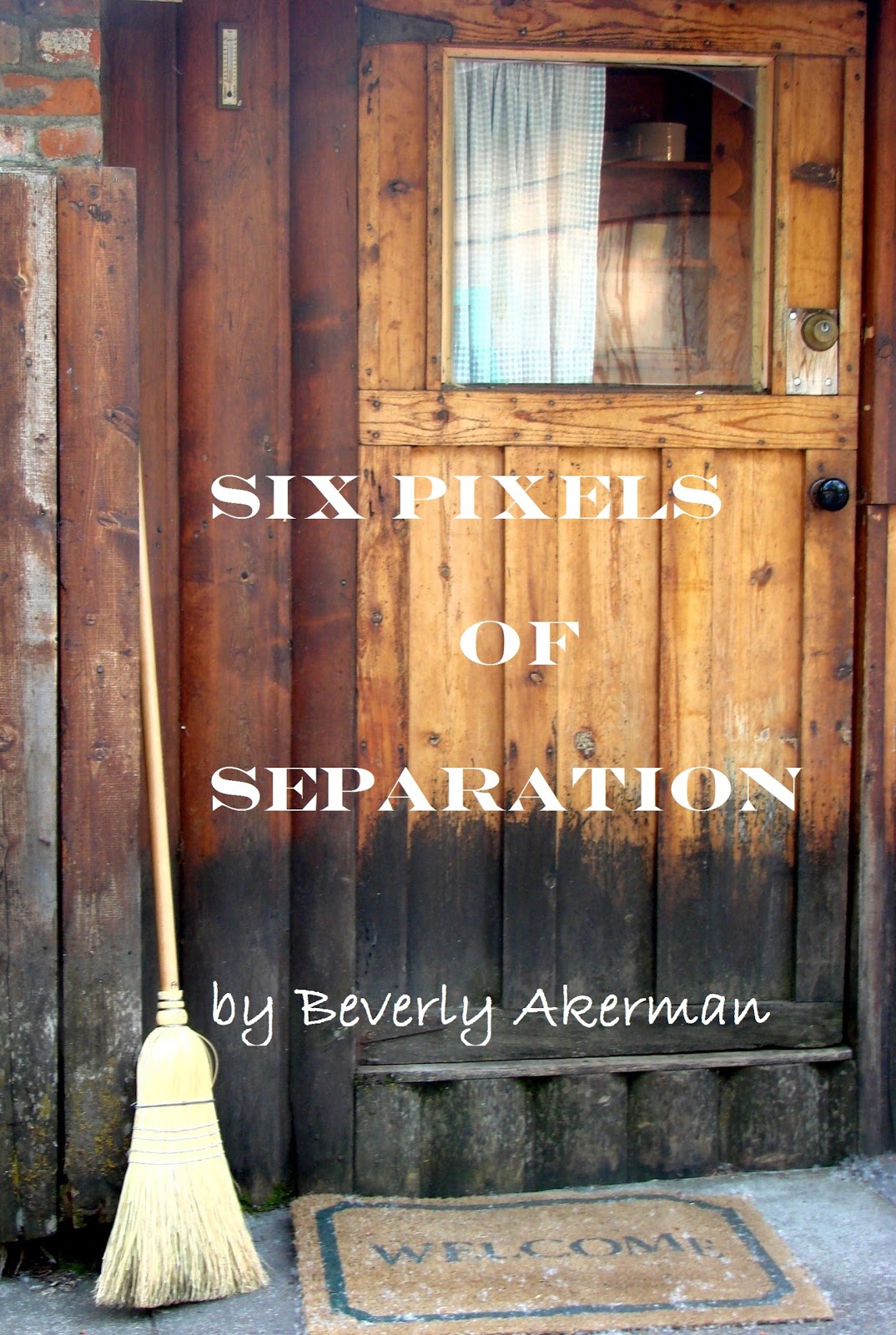
My Pushcart nominated essay, "Six Pixels of Separation," now available at Amazon
What a fantastic essay!
I love it more with each reading!
~ Sylvia Legris, Editor, Grain Magazine
I'm pleased to announce that my Pushcart Prize nominated essay, "Six Pixels of Separation," has just been published at Amazon.com . Normally, I would have put it up on this blog...but I've now accepted (just like The New York Times) that writers must be compensated for their work, and so this 4,000 word piece is available online for the nominal sum of $2.99 (USD).
Six Pixels of Separation originally appeared in Grain Magazine during Sylvia Legris' tenure (Vol. 37.4, Summer 2010, p. 34-43, for those of you who want to read along at home).
This is one of my very favourite pieces since I started writing full-time in 2005 and I'm very glad to be able to share it with you in this lovely edition, featuring a photograph of the cabin we five Fishtrap Fellows used when we were welcomed to the 2008 Summer Fishtrap Writing Conference.
Here we are at Fishtrap back in 2008 (funny that all five Fellows that year were women...we called ourselves the Fellas). These are some of the most impressive writers I have ever been privileged to meet, and I'm thrilled to be able to introduce them to you here, in case you haven't yet "met" them. From left: Jennifer D. Munro (originally from Hawaii, a woman who writes with affecting humour of her fertility travails--please see The Erotica Writer's Husband and Other Stories), me, Judith Groudine Finkel, novelist, and author of the moving short story "Two by Four", and two wonderful poets, Anna Ross (Hawk Weather), and Lorraine Healey whose The Habit of Buenos
Aires won the Patricia Bibby First Book Award.
Here's the blurb from Six Pixels of Separation; I do hope you find the time to check it out!
"A
couple of summers ago, I flew from my home in Montreal
across the continent to Oregon
for the first time, on points cadged from my husband. He travelled a lot for
work. Because I quit science to pursue art several years back, I sponge off him
shamelessly these days. And not just for plane tickets..."
One evening, after an argument with her husband about sex, Beverly Akerman wraps herself in a blanket and starts reading Raymond Carver. What follows is a heartfelt melding of reflections on love, sex, the Holocaust, evolution, literature, coincidence, windmills, and a trip to and from the Wallowa Lake, Oregon, celebration of writing and life known as Fishtrap. Read this astonishing essay by a major new writing talent.
Essay section headings:
I: Irrigator evolution
II: Moraines
III: Raymond
IV: Darwin’s
faith
V: Making a difference
VI: Valuables
VII: Keeping track
VIII: The fellowship of the rings
IX: Renard
X: Rich
XI: The
Dalles
XII: Change
XIII: Conflict
XIV: La langue française
XV: Arbeit
macht Frei
XVI: RT
XVII: The hard part
XVIII: Windmillus
sapiens sapiens
Includes 13 footnotes.
PAY THE WRITER!
Labels:
amazon,
anna ross,
essay,
fishtrap,
Grain Magazine,
jennifer d. munro,
judith groudine finkel,
kindle,
lorraine healy,
National Magazine Award,
Pushcart,
Six Pixels of Separation,
sylvia legris
Sunday, 14 October 2012
The Meaning of Children and The Bad Review
The Meaning of Children is divided into three parts, featuring stories with protagonists who are children, in the parenting years, or elders. Though I wish it were otherwise, many of the book’s stories are dark, reminding me of that Tolstoy maxim “All happy families are alike; each unhappy family is unhappy in its own way,” and its corollary, “If it’s happy, it’s not literature.”
Growing up, without the rose coloured glasses. To paraphrase Katie Hewitt in The Globe and Mail, these aren’t
the wonder years.
But reading a book is like taking a Rorschach test: what you get from
it is deeply entwined with what you bring to it, with who you are.
Which brings us to The Bad Review. Writers are usually
admonished to ignore The Bad Review (hopefully, there will only be one!) and
focus on the good, and there is much wisdom in that advice. I have also been
blessed to have received so much wonderful, positive feedback. But there is
also much to be learned from the negative review…and so, despite the kerfuffle
between Michael Lista in the National Post and CWILA, based on the earlier call and response round between Jan Zwicky and Zach Wells, I believe in writing, reading, and acknowledging, the bad review. And
so, here is a discussion of mine.
Bee
Markus oversimplified terribly when she wrote
“what the fourteen stories in Akerman’s collection do is describe the myriad ways
that mothering and marriage can damage and destroy a woman’s soul and spirit.”
(B.A. Markus, mRb, vol. 14, no. 3,
Summer 2011. Reproduced below; archived here).
There’s
no doubt in my mind “that mothering and marriage can damage and destroy a woman’s soul and spirit (emphasis mine).”
Not always, but sometimes. The thing is, my work doesn’t shy away from that. My
book takes on the female experience, leaving behind the rose-tinted glasses.
Maybe, deep in the heart of the mothering years, it can be hard to appreciate
what, exactly, one is sacrificing. Maybe a little denial is not a bad thing.
But (in my opinion)
there is much more in the book than what Markus saw; maybe the review says as
much about her as it does about the book. That she saw the child point-of-view
stories as introducing “the mother as a resentful victim” completely misses the
point: that to grow up is to peel a series of layers of knowledge gleaned from
experience. That growing up doesn’t end with an eighteenth birthday. It’s a
lifelong trip.
Markus’s
real problem may have been with the paperback’s cover: all those happy photos
suggesting a light-hearted tiptoe through the parenting tulips. This was my
publisher’s choice, part of the Faustian bargain that must be struck between
gaining the reader (and, more importantly, the bookseller marketing
department’s) interest and giving the flavour of the contents. I love the
paperback cover and gave it my blessing, though I also warned it might lead to exactly
the sort of reaction Markus appears to have had: the suggestion “that the
stories behind the cover will most certainly be heart-warming vignettes
celebrating the innumerable gifts that children bring to our lives.”
Several
women, some “of a certain age,” as we say here in French, actually commented
that the book was so much better than they thought it would be, based on the
cover. They’ve had enough of the saccharine view that a woman’s life is
consummated by motherhood. Which is one reason why I had a problem with Richard
Wright’s Clara Callan, where Clara’s
inner life, as represented in the series of letters she’s been writing, ends
with the birth of her child.
I heartily acknowledge that my book probes the dark hearts of
growing up and of mothering, but I also feel that the book as a whole is a much more balanced
portrayal than Markus—and mRb--let on.
Happily-ever-afterish stories do appear: “Paternity” and “The Woman with Deadly
Hands” spring immediately to mind. What I’ve tried to do is to show you my 14
snapshots of life, with compassion. And without glossing over the hard parts.
So, there you have it. My take on The Bad Review. Of course, every writer should be grateful for every single review, good, bad, or indifferent. It means that serious readers seriously considered your work. Which is what every writer dreams of...or, at least, what this writer dreams of.
Thankfully, there are a number of other, much more positive takes from
reviewers and other readers. You may find many of them here.
The Meaning of Children is available as a paperback (~$15) or an e-book ($5). Decide for yourself.
Labels:
AELAQ,
amazon,
books,
canlit,
childhood,
CWILA,
ebook,
free,
freebie,
Jan zwicky,
kindle,
michael lista,
mRb,
paperback,
parenting,
reviewing,
The Meaning of Children,
the national post,
writing,
zach wells
Friday, 21 September 2012
The Meaning of Children: Latest interview, at Inspiration Forum UK
From Inspiration Forum UK, September 2012
Thank you, Fiona McVie!
Our Interview with Beverly Akerman
Age North of 40, south of 60. Okay, you win: I’m 52.
Where are you from? Montreal, Quebec, Canada.
A little about your self ie. your education, family life, etc.
Born and raised in Montreal. In fact, I’ve never lived anywhere else. Sometimes I feel a bit bad about that, like it’s a character flaw or something. I have three kids well on their way to being grown-up. One moved out of the house to live on his own just this summer…and it was my middle guy, the one who’s always been easiest to get along with and the most helpful. (Or maybe it just seems that way; hindsight, rose coloured glasses and all that. Still, he was the only one of the three who used to point to his bed at night when we’d be rocking him in the rocking chair. He did like his sleep!) My husband is still here at home with me. I’m happy about that, actually. He worked in politics for many years, while our family was young. So I worked full-time, mostly, and single-parented it half the time.
I was busy and exhausted, so over-programmed that I don’t have all that many memories of that period. Why do we do this to ourselves? I suppose you’ve heard the saying, “Of course women can have it all: just not all at the same time.”
I have BSc and MSc degrees in biology from McGill University and worked for over 20 years in molecular genetics research. But I’d always known I’d be a writer some day. (At least, I’d always wanted/intended/hoped to be a writer some day…)
Fiona: Tell us your latest news?
I just had my longest ever giveaway on Amazon for the e-version of my award winning short story collection, The Meaning of Children, and it went really well. Over 4300 downloads, which I think is amazing for literary fiction. And the reviews—from periodicals as well as “real” readers-- are absolutely incredible as well. Words like “luminous,” “illuminated,” “haunting,” “a life-altering read,” “profound,” “a book of rare sensitivity and masterful creative writing”…You’d have to look on the Amazon.com book page to see them (it hasn’t quite caught on yet in the UK, I’m afraid) and on my blog.
Here are some links:
http://www.amazon.com/The-Meaning-of-Chi...B007H067R6
http://www.amazon.co.uk/The-Meaning-of-C...B007H067R6
http://beverlyakerman.blogspot.ca/p/rad-...aning.html
Fiona: When and why did you begin writing?
I'd always thought I'd be a writer some day. My first publication was a poem that won an honourable mention when I was nine and a half years old, something I wrote about in The Rampike last year, in the creative nonfiction piece "Aversion Conditioning, or Why I am Somewhat Conflicted About Poetry.” But I guess my imagination-my self confidence?-failed me because I could never seriously picture myself as a writer. So I put it aside, joked about needing to live life first in order to have something to write about (though maybe that isn't a joke), and tried to prove something (though exactly what and to whom I'm not quite sure) by distinguishing myself in math and science, the subjects everybody else seemed to think were the hardest.
I'd been keen on genetics since first learning about it in high school and in grade 10, when we were offered testing for Tay Sachs disease carrier status and one of my friends tested positive, I was well and duly hooked on DNA.
I majored in biology (human genetics) and went on to graduate work in genetics, where one of my most cherished delusions was that, once I finished the residency requirement and no longer paid by the credit, I'd be able to take all the English and creative writing courses I'd always dreamt of.
Guess how much time I had for non-science courses while pursuing a research degree in genetics?
That's right: none.
By 2003, I'd been in science for over two decades, mostly in McGill-affiliated labs. I'd been fairly successful, writing or co-writing 19 papers, mostly on mutations associated with several rare diseases. I also had a life--three kids and a husband who made a career in politics. But a funny thing happened as I waltzed through the genomes: the work had started to lose its meaning for me.
Something was wrong, I just couldn't put my finger on what, exactly.
And then my father-in-law, Gerry Copeman, died of lung cancer.
Gerry and I didn't even get along that well, although we'd made our peace, especially after the grandchildren arrived. But when he died, it affected me deeply, beyond the sadness of losing someone so close. For the first time, I understood-emotionally, as opposed to rationally or intellectually-that my time on this earth was finite, and that I'd better use it doing something I'd always dreamed of doing.
Which turned out to be, once I spent some time trying to figure it out, writing fiction.
So I switched gears, started taking writing workshops-the Quebec Writers' Federation has been stellar in providing learning opportunities for someone like me, unsure if she wanted to go back to university (and, more importantly, not convinced it would be helpful to have roomsful of young strangers tear up her work). I've been writing and submitting like mad ever since.
My first stories were published-online and in print-in 2006. Within a few years, I'd published more than 20 stories-in anthologies like the Aesthetica Creative Writing Annual 2012 and Best New Writing 2011, as well as literary journals and won or placed in a slew of contests. Links to my stories available online are on my blog. But let me direct you to a favourite of mine (and of my readers), “Pie.” It’s about love and loss, motherhood, baking, childrearing, and war.
And you can read it here:
http://beverlyakerman.blogspot.ca/2011/05/pie.html
Fiona: When did you first consider yourself a writer?
I’ve probably always considered myself a writer trapped in a non-writing body…but I remember when I won the Fog City Writers Fiction Contest…I opened the email and screamed. Hubby came running, thinking someone had died. But it was just that I’d won a $1,000 prize. I think that was the moment when I thought, “Okay, it’s not my imagination, this really is good work.” That was October 10th, 2007 (I had to look it up).
Fiona: How did you come up with the title?
I’d read somewhere that bestsellers were typically titled “The noun of noun” and so I played with that. The thing is, when I sat back and looked at the pile of stories I’d writing, the theme of children wasn’t hard to spot. I also realized, after submitting the collection for a while and getting nowhere with it (I am extremely impatient about such things) that I needed to have an overall structure to the book. So I thought about it some more and realized I could divide the book into “beginning”—stories from a child’s point of view—“middle”—about those in the child bearing years--and “end”—about older people, or stories that take the long view of life. And pretty soon after that, it was accepted for publication in Canada by Exile Editions.
Fiona: Is there a message in your story collection that you want readers to grasp?
You know, I think about that from time to time. There are 14 stories and I’d say that each of them has its own message and meaning, which may differ from reader to reader (and reading to reading). That’s what makes them literary, I guess.
I think one of the overall messages of the collection is about noticing those small moments of growth and insight, and that being a kid can be hard. Being a grown-up can be hard, too. And being a parent, a mother…well, let’s just say I wanted to shine the light on some feelings that are deep but not that much discussed. And they aren’t all dark, but some of them are.
Fiona: How much of the book is realistic?
Much of the book is quite realistic but I do have one story, “The Woman with Deadly Hands,” which, as you can tell from the title, is a bit of a fairy tale. But it’s a fairy tale for grown-ups. There’s sex in it, homosexuality, a deep dark secret, and a HEA ending (for happily ever after). Many of the themes, in fact, are similar to those in Fifty Shades of Grey, which is one of the reasons that trilogy appealed to me, though I don’t write soft porn. Probably more lucrative if I did!
Fiona: Are experiences based on someone you know, or events in your own life?
I tell everyone that the book is fiction. My kids always roll their eyes (or smirk, or both!) at that. So I’d have to also say some of the stories are based on real events in my own life, or those of people I know. But if real life is the basis of a story, I still take it and move it beyond the quotidian. Something has to happen to that interesting character, IMHO. Or it’s not really a story.
Fiona: What books have most influenced your life most?
As a writer? Mordecai Richler’s Barney’s Version is pretty much perfect, in my view. It’s largely about Montreal, it features characters brash and larger than life, it’s a book about the love of a man for his wife and children, it’s poignant and moving and very, very funny. A writer at the top of his game. If I could write something that had all that—humour, love of family, poignancy—I’d consider myself a success.
More recently, I’ve really enjoyed Lionel Shriver’s fearlessness in We Have to Talk About Kevin, and Michael Chabon’s tour de force The Amazing Adventures of Kavalier & Klay.
Fiona: If you had to choose, which writer would you consider a mentor?
I don’t think I could choose just one…there’s Colleen Curran, a playwright I’ve been studying with for the past few years. She is just incredibly motivating and supportive, and a wonderful all round bubbly person. She is a sucker for comedy and happily ever after (see her play Cake Walk or her novels, e.g. Something Drastic) but she has also written much more serious work (El Cladavista, Sacred Hearts).
Then there’s Neale McDevitt; I took writing workshops with him for about 18 months. He has a wonderful book of short fiction, One Day Even Trevi Will Crumble, quite a prescient title because I recently read that the fountain was out of commission for awhile after several chunks of it had broken away. Other writing teachers of who really stand out in my mind: Luis Alberto Urrea, and Nancy Zafris.
Fiona: What book are you reading now?
Right now I’m reading Half of a Yellow Sun by Chimamanda Ngozi Adichie for book club and really enjoying that.
Fiona: Are there any new authors that have grasped your interest?
All of them. Martin Crosbie, author of My Temporary Life, for example. Poet Samuel Peralta who is new to me, anyway. I’m learning so much on this indie experiment of mine.
Fiona: What are your current projects?
I’m still trying to figure out how to write a novel. I know how to start them, no problem. It’s keeping them going…that’s what I have to work on. I also have a couple of plays on the go.
Fiona: Name one entity that you feel supported you outside of family members.
Oh, there are many of those! An entire alphabet soup of initials: PWAC, for the Professional Writers Association of Canada, which helped me earn a (bit of? Modest?) living as a freelance writer; the QWF (Quebec Writers’ Federation), which made all the lovely writing workshops available for modest fees, the WFNB (Writers Federation of New Brunswick) for running the David Adams Richards Prize Contest, and; my Canadian publisher, Exile Editions.
Fiona: If you had to do it all over again, would you change anything in your latest book?
Yes: I wouldn’t have worried so much about no one wanting to publish it. I wouldn’t have said “yes” to the first offer; I would have investigated what a publisher was willing to do for me. I would have had more faith in my own talent.
Fiona: Do you have a blog/website? if so what is it?
http://beverlyakerman.blogspot.ca/
Thank you, Fiona McVie!
![]() |
| Those books aren't just going to read themselves, you know... |
Name Beverly Akerman
Age North of 40, south of 60. Okay, you win: I’m 52.
Where are you from? Montreal, Quebec, Canada.
A little about your self ie. your education, family life, etc.
Born and raised in Montreal. In fact, I’ve never lived anywhere else. Sometimes I feel a bit bad about that, like it’s a character flaw or something. I have three kids well on their way to being grown-up. One moved out of the house to live on his own just this summer…and it was my middle guy, the one who’s always been easiest to get along with and the most helpful. (Or maybe it just seems that way; hindsight, rose coloured glasses and all that. Still, he was the only one of the three who used to point to his bed at night when we’d be rocking him in the rocking chair. He did like his sleep!) My husband is still here at home with me. I’m happy about that, actually. He worked in politics for many years, while our family was young. So I worked full-time, mostly, and single-parented it half the time.
I was busy and exhausted, so over-programmed that I don’t have all that many memories of that period. Why do we do this to ourselves? I suppose you’ve heard the saying, “Of course women can have it all: just not all at the same time.”
I have BSc and MSc degrees in biology from McGill University and worked for over 20 years in molecular genetics research. But I’d always known I’d be a writer some day. (At least, I’d always wanted/intended/hoped to be a writer some day…)
Fiona: Tell us your latest news?
I just had my longest ever giveaway on Amazon for the e-version of my award winning short story collection, The Meaning of Children, and it went really well. Over 4300 downloads, which I think is amazing for literary fiction. And the reviews—from periodicals as well as “real” readers-- are absolutely incredible as well. Words like “luminous,” “illuminated,” “haunting,” “a life-altering read,” “profound,” “a book of rare sensitivity and masterful creative writing”…You’d have to look on the Amazon.com book page to see them (it hasn’t quite caught on yet in the UK, I’m afraid) and on my blog.
Here are some links:
http://www.amazon.com/The-Meaning-of-Chi...B007H067R6
http://www.amazon.co.uk/The-Meaning-of-C...B007H067R6
http://beverlyakerman.blogspot.ca/p/rad-...aning.html
Fiona: When and why did you begin writing?
I'd always thought I'd be a writer some day. My first publication was a poem that won an honourable mention when I was nine and a half years old, something I wrote about in The Rampike last year, in the creative nonfiction piece "Aversion Conditioning, or Why I am Somewhat Conflicted About Poetry.” But I guess my imagination-my self confidence?-failed me because I could never seriously picture myself as a writer. So I put it aside, joked about needing to live life first in order to have something to write about (though maybe that isn't a joke), and tried to prove something (though exactly what and to whom I'm not quite sure) by distinguishing myself in math and science, the subjects everybody else seemed to think were the hardest.
I'd been keen on genetics since first learning about it in high school and in grade 10, when we were offered testing for Tay Sachs disease carrier status and one of my friends tested positive, I was well and duly hooked on DNA.
I majored in biology (human genetics) and went on to graduate work in genetics, where one of my most cherished delusions was that, once I finished the residency requirement and no longer paid by the credit, I'd be able to take all the English and creative writing courses I'd always dreamt of.
Guess how much time I had for non-science courses while pursuing a research degree in genetics?
That's right: none.
By 2003, I'd been in science for over two decades, mostly in McGill-affiliated labs. I'd been fairly successful, writing or co-writing 19 papers, mostly on mutations associated with several rare diseases. I also had a life--three kids and a husband who made a career in politics. But a funny thing happened as I waltzed through the genomes: the work had started to lose its meaning for me.
Something was wrong, I just couldn't put my finger on what, exactly.
And then my father-in-law, Gerry Copeman, died of lung cancer.
Gerry and I didn't even get along that well, although we'd made our peace, especially after the grandchildren arrived. But when he died, it affected me deeply, beyond the sadness of losing someone so close. For the first time, I understood-emotionally, as opposed to rationally or intellectually-that my time on this earth was finite, and that I'd better use it doing something I'd always dreamed of doing.
Which turned out to be, once I spent some time trying to figure it out, writing fiction.
So I switched gears, started taking writing workshops-the Quebec Writers' Federation has been stellar in providing learning opportunities for someone like me, unsure if she wanted to go back to university (and, more importantly, not convinced it would be helpful to have roomsful of young strangers tear up her work). I've been writing and submitting like mad ever since.
My first stories were published-online and in print-in 2006. Within a few years, I'd published more than 20 stories-in anthologies like the Aesthetica Creative Writing Annual 2012 and Best New Writing 2011, as well as literary journals and won or placed in a slew of contests. Links to my stories available online are on my blog. But let me direct you to a favourite of mine (and of my readers), “Pie.” It’s about love and loss, motherhood, baking, childrearing, and war.
And you can read it here:
http://beverlyakerman.blogspot.ca/2011/05/pie.html
Fiona: When did you first consider yourself a writer?
I’ve probably always considered myself a writer trapped in a non-writing body…but I remember when I won the Fog City Writers Fiction Contest…I opened the email and screamed. Hubby came running, thinking someone had died. But it was just that I’d won a $1,000 prize. I think that was the moment when I thought, “Okay, it’s not my imagination, this really is good work.” That was October 10th, 2007 (I had to look it up).
Fiona: How did you come up with the title?
I’d read somewhere that bestsellers were typically titled “The noun of noun” and so I played with that. The thing is, when I sat back and looked at the pile of stories I’d writing, the theme of children wasn’t hard to spot. I also realized, after submitting the collection for a while and getting nowhere with it (I am extremely impatient about such things) that I needed to have an overall structure to the book. So I thought about it some more and realized I could divide the book into “beginning”—stories from a child’s point of view—“middle”—about those in the child bearing years--and “end”—about older people, or stories that take the long view of life. And pretty soon after that, it was accepted for publication in Canada by Exile Editions.
Fiona: Is there a message in your story collection that you want readers to grasp?
You know, I think about that from time to time. There are 14 stories and I’d say that each of them has its own message and meaning, which may differ from reader to reader (and reading to reading). That’s what makes them literary, I guess.
I think one of the overall messages of the collection is about noticing those small moments of growth and insight, and that being a kid can be hard. Being a grown-up can be hard, too. And being a parent, a mother…well, let’s just say I wanted to shine the light on some feelings that are deep but not that much discussed. And they aren’t all dark, but some of them are.
Fiona: How much of the book is realistic?
Much of the book is quite realistic but I do have one story, “The Woman with Deadly Hands,” which, as you can tell from the title, is a bit of a fairy tale. But it’s a fairy tale for grown-ups. There’s sex in it, homosexuality, a deep dark secret, and a HEA ending (for happily ever after). Many of the themes, in fact, are similar to those in Fifty Shades of Grey, which is one of the reasons that trilogy appealed to me, though I don’t write soft porn. Probably more lucrative if I did!
Fiona: Are experiences based on someone you know, or events in your own life?
I tell everyone that the book is fiction. My kids always roll their eyes (or smirk, or both!) at that. So I’d have to also say some of the stories are based on real events in my own life, or those of people I know. But if real life is the basis of a story, I still take it and move it beyond the quotidian. Something has to happen to that interesting character, IMHO. Or it’s not really a story.
Fiona: What books have most influenced your life most?
As a writer? Mordecai Richler’s Barney’s Version is pretty much perfect, in my view. It’s largely about Montreal, it features characters brash and larger than life, it’s a book about the love of a man for his wife and children, it’s poignant and moving and very, very funny. A writer at the top of his game. If I could write something that had all that—humour, love of family, poignancy—I’d consider myself a success.
One of the things that means the most to me about it is that it’s about
the love of a Jewish man for his Jewish wife…which is a kind of long
story for me. Let’s just say that most male Jewish authors do not write
about lovely and lovable Jewish women. If you like, you can read up on
that here:
http://roverarts.com/2010/12/mordecai%E2%80%99s-women/
and here (because that was one of the few changes in the story when it was turned into film)
http://roverarts.com/2011/01/mordecai%E2...not-quite/
Other books that are important to me: Morley Callaghan’s The Loved and the Lost. I was very young when I read it and it impressed me immeasurably because it showed me my own home, Montreal, could be the setting for an important novel.
Then there’s the usual: Catcher in the Rye, To Kill a Mockingbird, both
of which I re-read recently. The latter astounded me: these are books
that are usually required reading for pre-teens here in Canada. So to
discover that To Kill a Mockingbird was as much about parenting as about
racism was a real eye-opener.
More recently, I’ve really enjoyed Lionel Shriver’s fearlessness in We Have to Talk About Kevin, and Michael Chabon’s tour de force The Amazing Adventures of Kavalier & Klay.
Fiona: If you had to choose, which writer would you consider a mentor?
I don’t think I could choose just one…there’s Colleen Curran, a playwright I’ve been studying with for the past few years. She is just incredibly motivating and supportive, and a wonderful all round bubbly person. She is a sucker for comedy and happily ever after (see her play Cake Walk or her novels, e.g. Something Drastic) but she has also written much more serious work (El Cladavista, Sacred Hearts).
Then there’s Neale McDevitt; I took writing workshops with him for about 18 months. He has a wonderful book of short fiction, One Day Even Trevi Will Crumble, quite a prescient title because I recently read that the fountain was out of commission for awhile after several chunks of it had broken away. Other writing teachers of who really stand out in my mind: Luis Alberto Urrea, and Nancy Zafris.
Fiona: What book are you reading now?
Right now I’m reading Half of a Yellow Sun by Chimamanda Ngozi Adichie for book club and really enjoying that.
Fiona: Are there any new authors that have grasped your interest?
All of them. Martin Crosbie, author of My Temporary Life, for example. Poet Samuel Peralta who is new to me, anyway. I’m learning so much on this indie experiment of mine.
Fiona: What are your current projects?
I’m still trying to figure out how to write a novel. I know how to start them, no problem. It’s keeping them going…that’s what I have to work on. I also have a couple of plays on the go.
Fiona: Name one entity that you feel supported you outside of family members.
Oh, there are many of those! An entire alphabet soup of initials: PWAC, for the Professional Writers Association of Canada, which helped me earn a (bit of? Modest?) living as a freelance writer; the QWF (Quebec Writers’ Federation), which made all the lovely writing workshops available for modest fees, the WFNB (Writers Federation of New Brunswick) for running the David Adams Richards Prize Contest, and; my Canadian publisher, Exile Editions.
Fiona: If you had to do it all over again, would you change anything in your latest book?
Yes: I wouldn’t have worried so much about no one wanting to publish it. I wouldn’t have said “yes” to the first offer; I would have investigated what a publisher was willing to do for me. I would have had more faith in my own talent.
Fiona: Do you have a blog/website? if so what is it?
http://beverlyakerman.blogspot.ca/
Labels:
books,
cancer,
emerging writer,
family,
Fiona Mcvie,
Inspiration Forum UK,
interview,
kindle,
motivation,
The Meaning of Children,
UK,
why write,
writing,
writing advice
Thursday, 19 July 2012
Celebrating Five Star Reviews with Paperback Giveaway
To celebrate some wonderful new reviews posted this month on The Meaning of Children's Amazon.com page, I'm giving away two PAPERBACK copies at Goodreads, starting tomorrow.
Goodreads Book Giveaway
The Meaning Of Children
by Beverly Akerman
Giveaway ends August 17, 2012.
See the giveaway details at Goodreads.
Here are the reviews; thanks so much to those who took the time to read and post their comments. It is very much appreciated!
5.0 out of 5 stars
A book that stays with you long after the last page is turned
By
The Meaning of Children was an absolute joy to read. I laughed out loud
at some stories and wept shamelessly at others, all the while savouring
every skillfully handpicked word. One cannot read The Meaning of
Children and not be moved in some way by the stories therein. It is a
beautiful quilt, made of exquisitely crafted pieces which when taken as a
whole is so much more than a sum of its parts. If you are looking for
the sort of book that will stay with you long after the last page is
turned, then look no further. I strongly recommend it.
I don't usually write reviews.
I don't usually read books of short stories.
I don't usually read outside my few favorite genres.
I first heard Ms Akerman's writing when she did a reading to promote this very book. I was struck by how strong her grasp of a child's voice was. How solid the writing, how soothing the prose and the thoughtful and stimulating story.
That's why I bought this book.
I haven't been disappointed. I love these stories. Every one of them solid, entertaining, thought provoking and just plain good.
Can't beat that.
Beverly Akerman is a master of "show not tell," phrases which I learned in all my creative writing classes. We get the picture in very few words. The situations in which the children find themselves are universal. They brought me back to my own childhood with all its thrills and tribulations.
We smile when we read how literal 11-year-old Karen interprets the following conversation with her friend Audrey:
"Last night, my mother told my father that she's going
to wear panties to bed every night. To prevent any
more accidents...I didn't want Audrey thinking I was
stupid, but around my house an 'accident' was whenever
my sister Lisa woke up with her bed wet" (p.46-47).
In addition, the book is so readable that I had trouble putting it down.
Beverly, please continue to write. I look forward to your next book.
5.0 out of 5 stars
Delightful stories
By
I don't usually read books of short stories.
I don't usually read outside my few favorite genres.
I first heard Ms Akerman's writing when she did a reading to promote this very book. I was struck by how strong her grasp of a child's voice was. How solid the writing, how soothing the prose and the thoughtful and stimulating story.
That's why I bought this book.
I haven't been disappointed. I love these stories. Every one of them solid, entertaining, thought provoking and just plain good.
Can't beat that.
5.0 out of 5 stars
"The Meaning of Children" by Beverly Akerman. Holstein, Ontario: Exile Editions, 2010
This book of short stories is one of the best books I have ever read
that gets right into the child's mind and way of thinking. The page
where the author describes the girl stopping to run because she had to
get her shorts out of her bum crack says it all. The fact that the
woman who's having an abortion is written in the third person is enough
to show us her ambivalent feelings. The contrast between the child's and parents' thinking adds another dimension to this book.Beverly Akerman is a master of "show not tell," phrases which I learned in all my creative writing classes. We get the picture in very few words. The situations in which the children find themselves are universal. They brought me back to my own childhood with all its thrills and tribulations.
We smile when we read how literal 11-year-old Karen interprets the following conversation with her friend Audrey:
"Last night, my mother told my father that she's going
to wear panties to bed every night. To prevent any
more accidents...I didn't want Audrey thinking I was
stupid, but around my house an 'accident' was whenever
my sister Lisa woke up with her bed wet" (p.46-47).
In addition, the book is so readable that I had trouble putting it down.
Beverly, please continue to write. I look forward to your next book.
5.0 out of 5 stars
Everything is Illuminated
By
Before reading "The Meaning of Children" by Beverly Akerman - winner of
the David Adams Richards Prize for Fiction - the last time my jaw
dropped over a short story collection was when I re-discovered Raymond
Carver's "What We Talk About When We Talk About Love." With both
collections, as I read the first few stories, I began to be aware that
this was no mere entertainment, but an illumination. In Akerman's case,
this epiphany is not just of childhood but of life, our own lives, our
entire lives - as children, growing up, as adults - transfigured through
the eyes and experience and innocence of children.
Akerman's
writing is precise - making the landscapes of Montreal and environs come
alive with microscopic detail - and impressive in its ability to
conjure believable first-person narratives, especially when it comes
from the point of view of a child. More than that, Akerman maintains a
sense of wonder throughout her collection with writing that borders on
poetry, displaying the brilliance of a Jonathan Safran Foer without the
modernist literary devices of flipbooks, photographs or typographical
gymnastics.
Remarkable in its intensity and craft, "The Meaning of Children" is a book that bears discovering, and Akerman a writer to watch.
Mortimer Levy Montreal.
Remarkable in its intensity and craft, "The Meaning of Children" is a book that bears discovering, and Akerman a writer to watch.
5.0 out of 5 stars
The Meaning of Children, July 4, 2012
By
Have just finished reading this wonderfully entertaining book,....for
the second time. My only criticism is that it's not lengthy enough. Ms.
Akerman is a master of the written phrase. With a minimum of dialogue
in each of the short stories, she is able to communicate in few words
virtually every human emotion and experience. The stories are an
endorsement of how childhood experiences can influence adult
development., how the conscious and subconscious memories can shape the
personality and destiny of an adult. It is a well researched book.
Much can be learned from the tidbits of psychology and human biology
that are sprinkled throughout the book.
Mortimer Levy Montreal.
Labels:
Amazon.com,
five star,
free books,
giveaway,
Goodreads,
gratitude,
kindle,
paperback,
readers,
reviews,
The Meaning of Children
Friday, 25 May 2012
‘THE MEANING OF CHILDREN’ E-BOOK FREE on May 25th & 26th!
‘THE MEANING OF CHILDREN’ FREE to download on May 25th & 26th!
PLEASE SHARE!
"A luminous talent." ~JoAnne Soper-Cook, author of 'Waterborne' and Judge, 2010 David Adams Richards Prize
![]() |
If you don't have a Kindle, Amazon.com has free apps for phones, tablets, and computers
34 LIKES, 4.6/5 STARS (5 reviews) for 'The Meaning of Children'
Readers call 'THE MEANING OF CHILDREN': "captivating," "pitch perfect prose," “resonates with the sad truth of being a grownup,” “touching without being maudlin, a true literary feat.”
Some recent reviews:
"I can't stop thinking about this book. It's been over a week since I read this collection of short stories and the characters are still with me.
"These are stories about real people, real children, teenagers, adults, in real times. I went through a whole range of emotions when I read them, some good, some not so good. When the child was sitting on the stairs listening to her parents, I was right there with her. When the adult was sitting by the lake contemplating what happened years before and looking at her present day life, I was sitting across from her, doing the same thing. I can't remember a book, let alone a collection of short stories, where I could identify so heavily with the emotions and feelings of the characters.
"As far as I'm concerned, this is what good writing, and a good book, should do for you. Yes, it entertained for sure, but it made me think and remember.
"If you enjoy quality writing and a book that will make you think about where you've been and where you're going read The Meaning Of Children.
"Highly recommended." ~Martin Crosbie on Amazon.com (5 stars)
"Akerman takes you back to the time you were a child. No matter you did not grow up in Montreal or Jewish, the situations, conflicts, joys and fears are universal. Akerman grounds emotions with rich descriptions and a strong sense of place." ~twalker on Amazon.com (4 stars)
"Entering the world of 'The Meaning Of Children' is like wrapping myself in the blanket my grandmother knit for me.I can feel every word, hear every sound, and be taken to a familiar place in my soul. You are a brilliant woman with a great spirit whose writing will resonate with many. Thank you." ~Judith Litvack on Facebook
PLEASE VERIFY "$0.00" BEFORE HITTING "BUY" AT Amazon.com: http://amzn.to/KznFvA
Labels:
Amazon.com,
free,
freebie,
giveaway,
kindle,
kindle app,
kindle freebie,
The Meaning of Children
Wednesday, 23 May 2012
Thrilled with the new Kindle cover of 'The Meaning of Children'
Here it is, freshly minted, the new cover for the ebook version of The Meaning Of Children, available exclusively on Amazon.com.
But that doesn't mean that if you don't have a Kindle, you can't get this FREE DOWNLOAD!
Because Amazon.com has FREE apps that let you read on your assorted doodads, from phones, tablets, to computers (though I'm afraid not on Nooks or Kobos, I don't believe). Find them here.
And, if you've managed to read this far, here's a bonus: early notice that The Meaning of Children will be FREE on Amazon.com this coming Friday and Saturday, May 25th and 26th.
PLEASE VERIFY THE PRICE IS
"$0.00"
BEFORE HITTING "BUY"!!
As always, The Meaning of Children
is FREE to borrow
from the Kindle Lending Library
for Amazon Prime members.
Would love to know what you think of this
collection of 14 award-winning short stories.
You can leave me a "thumbs up" or, better still,
a REVIEW
on TMOC's Amazon.com page
(just click the link and sign in).
Here are the 5 amazing Amazon.com reviews the book has garnered so far, all 4- or 5-stars. A couple of dozen more are available elsewhere on my blog, as well as on the CBC-Scotiabank Giller Prize Readers' Choice Contest website.
"Akerman takes you back to the time you were a child. No matter you did
not grow up in Montreal or Jewish, the situations, conflicts, joys and
fears are universal. Akerman grounds emotions with rich descriptions
and a strong sense of place." ~twalker, San Francisco
"I can't stop thinking about this book. It's been over a week since I read this collection of short stories and the characters are still with me.
"These
are stories about real people, real children, teenagers, adults, in
real times. I went through a whole range of emotions when I read them,
some good, some not so good. When the child was sitting on the stairs
listening to her parents, I was right there with her. When the adult was
sitting by the lake contemplating what happened years before and
looking at her present day life, I was sitting across from her, doing
the same thing. I can't remember a book, let alone a collection of short
stories, where I could identify so heavily with the emotions and
feelings of the characters.
"As far as I'm concerned, this is what
good writing, and a good book, should do for you. Yes, it entertained
for sure, but it made me think and remember."If you enjoy quality writing and a book that will make you think about where you've been and where you're going read The Meaning Of Children. Highly recommended." ~ Martin Crosbie
"So many books, so little time... There are so many books on my bedside table waiting to be read that I
rarely revisit a book for a second time. The Meaning of Children is an
exception to that rule. On second reading, I find myself noticing
different details, things I didn't see the first time around. Akerman
has a deft ear for dialogue. Her characters sound true to life and true
to age. And somehow stories seem to have morphed on second reading. The
ending strikes me differently, or perhaps a character reminds me of
someone different. It's always worth the journey." ~K.J. Lieber, Montreal
"A vision of yesteryear. Having grown up myself in the late 50's and 60's, this well-crafted book
tells a revealing tale of hope and what the future may bring. Told from
the chilling perspective of several children, the question becomes, can
the soul of a child be healed? This book is gripping in its depiction
of being trapped in a socially inept world of that time, only to wake up
to realize that what's most important is that time is of the essence." ~ John R.
"Great book! Amazing book. Well written. Interesting stories. Very reflective. The
writing is excellent. I would highly recommend this to anyone and
everyone." ~Suzanne Boles, London ON
Thanks again to all the readers, "thumbs uppers" and reviewers!
Labels:
Amazon Prime,
Amazon.com,
ebook,
freebie,
giveaway,
kindle,
kindle app,
May 25,
May 26,
The Meaning of Children
Subscribe to:
Posts (Atom)